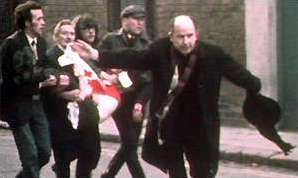
Domingo Sangrento (em gaélico: Domhnach na Fola, Bloody Sunday, em inglês) foi um confronto entre manifestantes católicos e protestantes, e o exército inglês ocorrido na cidade de Derry, na Irlanda do Norte, no dia 30 de janeiro de 1972.
O movimento teve início com um protesto de dez mil manifestantes que
pretendiam, saindo do bairro de Creggan em marcha pelas ruas
católicas da cidade, chegar até a Câmara Municipal. Antes disso,
entretanto, os soldados ingleses partiram para ofensiva e disparam
contra os manifestantes, deixando 14 ativistas católicos mortos e 26
feridos.
Das catorze vítimas mortas, seis eram menores de idade e um sétimo
ferido faleceu meses depois do incidente. Todas as vítimas estavam
desarmadas e cinco delas foram alvejadas pelas costas. Os manifestantes
protestavam contra a política do governo norte-irlandês de prender
sumariamente pessoas suspeitas de atos terroristas. O incidente, que
entrou para a história da ilha, era para apoiar o Exército Republicano Irlandês, o IRA, uma organização clandestina que lutava pela separação da Irlanda do Norte da Grã-Bretanha e posterior união com a República da Irlanda.
Após o "Domingo Sangrento", o IRA ganhou um número enorme de jovens
voluntários, dando força ainda maior a esse movimento de guerrilha.
Em memória da data, foi feita a canção "Sunday Bloody Sunday!" em 1983, pela banda irlandesa U2. Paul McCartney também tratou do incidente, na canção "Give Ireland Back To The Irish", lançada em compacto com sua então nova banda, os Wings, em fevereiro de 1972.
Duas investigações foram realizadas pelo Governo britânico. O Widgery Tribunal,
realizada no rescaldo do evento, ilibou em grande parte os soldados
britânicos e as autoridades da responsabilidade, mas foi criticado
por muitos como um "branqueamento" do incidente, incluindo pelo
antigo chefe de equipe de Tony Blair, Jonathan Powell. O Inquérito Saville, iniciado em 1998 para analisar os acontecimentos novamente (presidida por Lord Saville de Newdigate), apresentou um relatório, em 2010,
que mostrava que os soldados e autoridades do Reino Unido procederam
de forma errada, levando à apresentação de desculpas às famílias das
vítimas por parte do Primeiro Ministro do Reino Unido.
O Exército Republicano Irlandês (IRA) iniciara a sua campanha contra a
Irlanda do Norte ser uma parte do Reino Unido havia dois anos antes do
Bloody Sunday, mas a interpretação do evento impulsionaram enormemente o recrutamento e o apoio à organização.
O Bloody Sunday continua entre os mais importantes eventos dos apelidados Troubles da Irlanda do Norte, principalmente devido ao facto de ter sido levado a cabo pelo exército britânico.
in Wikipédia

The death
- John (Jackie) Duddy. Shot in the chest in the car park of Rossville flats. Four witnesses stated Duddy was unarmed and running away from the paratroopers when he was killed. Three of them saw a soldier take deliberate aim at the youth as he ran. He is the uncle of the Irish boxer John Duddy.
- Patrick Joseph Doherty. Shot from behind while attempting to crawl to safety in the forecourt of Rossville flats. Doherty was the subject of a series of photographs, taken before and after he died by French journalist Gilles Peress. Despite testimony from "Soldier F" that he had fired at a man holding and firing a pistol, Widgery acknowledged that the photographs showed Doherty was unarmed, and that forensic tests on his hands for gunshot residue proved negative.
- Bernard McGuigan. Shot in the back of the head when he went to help Patrick Doherty. He had been waving a white handkerchief at the soldiers to indicate his peaceful intentions.
- Hugh Pius Gilmour. Shot through his right elbow, the bullet then entering his chest as he ran from the paratroopers on Rossville Street. Widgery acknowledged that a photograph taken seconds after Gilmour was hit corroborated witness reports that he was unarmed, and that tests for gunshot residue were negative.
- Kevin McElhinney. Shot from behind while attempting to crawl to safety at the front entrance of the Rossville Flats. Two witnesses stated McElhinney was unarmed.
- Michael Gerald Kelly. Shot in the stomach while standing near the rubble barricade in front of Rossville Flats. Widgery accepted that Kelly was unarmed.
- John Pius Young. Shot in the head while standing at the rubble barricade. Two witnesses stated Young was unarmed.
- William Noel Nash. Shot in the chest near the barricade. Witnesses stated Nash was unarmed and going to the aid of another when killed.
- Michael M. McDaid. Shot in the face at the barricade as he was walking away from the paratroopers. The trajectory of the bullet indicated he could have been killed by soldiers positioned on the Derry Walls.
- James Joseph Wray. Wounded then shot again at close range while lying on the ground. Witnesses who were not called to the Widgery Tribunal stated that Wray was calling out that he could not move his legs before he was shot the second time.
- Gerald Donaghey. Shot in the stomach while attempting to run to safety between Glenfada Park and Abbey Park. Donaghey was brought to a nearby house by bystanders where he was examined by a doctor. His pockets were turned out in an effort to identify him. A later police photograph of Donaghey's corpse showed nail bombs in his pockets. Neither those who searched his pockets in the house nor the British army medical officer (Soldier 138) who pronounced him dead shortly afterwards say they saw any bombs. Donaghey had been a member of Fianna Éireann, an IRA-linked Republican youth movement. Paddy Ward, a police informer who gave evidence at the Saville Inquiry, claimed that he had given two nail bombs to Donaghey several hours before he was shot dead.
- Gerard (James) McKinney. Shot just after Gerald Donaghey. Witnesses stated that McKinney had been running behind Donaghey, and he stopped and held up his arms, shouting "Don't shoot! Don't shoot!", when he saw Donaghey fall. He was then shot in the chest.
- William Anthony McKinney. Shot from behind as he attempted to aid Gerald McKinney (no relation). He had left cover to try to help Gerald.
- John Johnston. Shot in the leg and left shoulder on William Street 15 minutes before the rest of the shooting started. Johnston was not on the march, but on his way to visit a friend in Glenfada Park. He died 4½ months later; his death has been attributed to the injuries he received on the day. He was the only one not to die immediately or soon after being shot.
in Wikipédia



Sem comentários:
Enviar um comentário