quinta-feira, abril 09, 2026
Phil Ochs morreu há cinquenta anos...

Ochs performed at many political events, including the 1968 Democratic National Convention, mass demonstrations sponsored by the National Mobilization Committee to End the War in Vietnam, civil rights rallies, student events, and organized labor events. Ochs initially described himself as a democratic socialist but grew more radical after the police riots at the 1968 Democratic National Convention.
After years of prolific writing in the 1960s, Ochs' mental stability declined in the 1970s as he struggled with bipolar disorder and alcoholism. He died by suicide on April 9, 1976.
Ochs's influences included Woody Guthrie, Pete Seeger, Buddy Holly, Elvis Presley, Bob Gibson, Faron Young, and Merle Haggard. His best-known songs include "I Ain't Marching Anymore", "When I'm Gone", "Changes", "Crucifixion", "Draft Dodger Rag", "Love Me, I'm a Liberal", "Outside of a Small Circle of Friends", "Power and the Glory", "There but for Fortune", and "The War Is Over".

(...)
Ochs's drinking became more and more of a problem, and his behavior became increasingly erratic. He frightened his friends both with his drunken rants about the FBI and CIA and about his claiming to want to have Elvis Presley's manager Colonel Tom Parker or Kentucky Fried Chicken's Colonel Sanders manage his career.
In mid-1975, Ochs took on the identity of John Butler Train. He told people that Train had murdered Ochs and that he, John Butler Train, had replaced him. Ochs was convinced that someone was trying to kill him, so he carried a weapon at all times: a hammer, a knife, or a lead pipe.
His brother, Michael, attempted to have him committed to a psychiatric hospital. Friends pleaded with him to get help voluntarily. They feared for his safety because he was getting into fights with bar patrons. Unable to pay his rent, he began living on the streets.
After several months, the Train persona faded and Ochs returned, but his talk of suicide disturbed his friends and family. They hoped it was a passing phase, but Ochs was determined. One of his biographers explains Ochs' motivation:
By Phil's thinking, he had died a long time ago: he had died politically in Chicago in 1968 in the violence of the Democratic National Convention; he had died professionally in Africa a few years later when he had been strangled and felt that he could no longer sing; he had died spiritually when Chile had been overthrown and his friend Victor Jara had been brutally murdered; and, finally, he had died psychologically at the hands of John Train.
On Christmas Eve 1975, Ochs visited the apartment of Larry Sloman and Dave Peller, which he had done semi-frequently near the end of 1975. On this particular evening, Peller recorded Ochs singing ten songs, five of them new and intended for an album that "would be an unflinching narrative of his psychosis over the past year" which went by the working title of Duels in the Sun. Five other songs were also at some level of completion by this time. A second tape, possibly recorded before Christmas Eve, features additional songs intended for this project. This album would never come to fruition beyond these two recordings.
In January 1976, Ochs moved to Far Rockaway, New York, to live with his sister Sonny. He was lethargic; his only activities were watching television and playing cards with his nephews. Ochs saw a psychiatrist, who diagnosed him with bipolar disorder. He was prescribed medication, and he told his sister he was taking it. On April 9, 1976, Ochs died by suicide, hanging himself in Sonny's home.
Years after his death, it was revealed that the FBI had a file of nearly 500 pages on Ochs. Much of the information in those files relates to his association with counterculture figures, protest organizers, musicians, and other people described by the FBI as "subversive". The FBI was often sloppy in collecting information about Ochs: his name was frequently misspelled "Oakes" in their files, and they continued to consider him "potentially dangerous" after his death.
Congresswoman Bella Abzug (Democrat from New York), an outspoken anti-war activist who had appeared at the 1975 "War is Over" rally, entered this statement into the Congressional Record on April 29, 1976:
Mr. Speaker, a few weeks ago, a young folksinger whose music personified the protest mood of the 1960s took his own life. Phil Ochs – whose original compositions were compelling moral statements against the war in Southeast Asia – apparently felt that he had run out of words.
While his tragic action was undoubtedly motivated by terrible personal despair, his death is a political as well as an artistic tragedy. I believe it is indicative of the despair many of the activists of the 1960s are experiencing as they perceive a government that continues the distortion of national priorities that is exemplified in the military budget we have before us.
Phil Ochs's poetic pronouncements were part of a larger effort to galvanize his generation into taking action to prevent war, racism, and poverty. He left us a legacy of important songs that continue to be relevant in 1976 - even though "the war is over".
Just one year ago - during this week of the anniversary of the end of the Vietnam War - Phil recruited entertainers to appear at the "War is Over" celebration in Central Park, at which I spoke.
It seems particularly appropriate that this week we should commemorate the contributions of this extraordinary young man.
Robert Christgau, who had been so critical of Pleasures of the Harbor and Ochs's guitar skills eight years earlier, wrote warmly of Ochs in his obituary in The Village Voice. "I came around to liking Phil Ochs's music, guitar included," Christgau wrote. "My affection [for Ochs] no doubt prejudiced me, so it is worth [noting] that many observers who care more for folk music than I do remember both his compositions and his vibrato tenor as close to the peak of the genre.
sexta-feira, dezembro 19, 2025
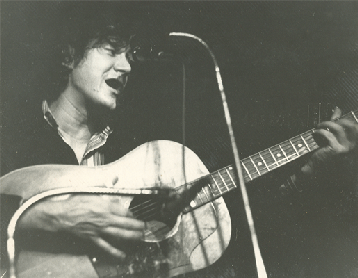
Phil Ochs nasceu há 85 anos...
(...)
quarta-feira, abril 09, 2025
Phil Ochs suicidou-se há 49 anos...

(...)
quinta-feira, dezembro 19, 2024
Phil Ochs nasceu há oitenta e quatro anos...
.jpg/800px-20111015_174748_phil-ochs_(cropped).jpg)
Philip David "Phil" Ochs (El Paso, Texas, December 19, 1940 – Far Rockaway, New York City, April 9, 1976) was an American protest singer (or, as he preferred, a topical singer) and songwriter who was known for his sharp wit, sardonic humor, earnest humanism, political activism, insightful and alliterative lyrics, and distinctive voice. He wrote hundreds of songs in the 1960s and '70s and released eight albums.
Ochs performed at many political events during the 1960s counterculture era, including anti-Vietnam War and civil rights rallies, student events, and organized labor events over the course of his career, in addition to many concert appearances at such venues as New York City's Town Hall and Carnegie Hall. Politically, Ochs described himself as a "left social democrat" who became an "early revolutionary" after the protests at the 1968 Democratic National Convention in Chicago led to a police riot, which had a profound effect on his state of mind.
After years of prolific writing in the 1960s, Ochs's mental stability declined in the 1970s. He eventually succumbed to a number of problems including bipolar disorder and alcoholism, and died by suicide in 1976.
Some of Ochs's major musical influences were Woody Guthrie, Pete Seeger, Buddy Holly, Elvis Presley, Bob Gibson, Faron Young, and Merle Haggard. His best-known songs include "I Ain't Marching Anymore", "Changes", "Crucifixion", "Draft Dodger Rag", "Love Me, I'm a Liberal", "Outside of a Small Circle of Friends", "Power and the Glory", "There but for Fortune", and "The War Is Over".
terça-feira, abril 09, 2024
Phil Ochs morreu há 48 anos...
(...)
terça-feira, dezembro 19, 2023
Phil Ochs nasceu há oitenta e três anos...
Philip David "Phil" Ochs (El Paso, Texas, December 19, 1940 – Far Rockaway, New York City, April 9, 1976) was an American protest singer (or, as he preferred, a topical singer) and songwriter who was known for his sharp wit, sardonic humor, earnest humanism, political activism, insightful and alliterative lyrics, and distinctive voice. He wrote hundreds of songs in the 1960s and '70s and released eight albums.
Ochs performed at many political events during the 1960s counterculture era, including anti-Vietnam War and civil rights rallies, student events, and organized labor events over the course of his career, in addition to many concert appearances at such venues as New York City's Town Hall and Carnegie Hall. Politically, Ochs described himself as a "left social democrat" who became an "early revolutionary" after the protests at the 1968 Democratic National Convention in Chicago led to a police riot, which had a profound effect on his state of mind.
After years of prolific writing in the 1960s, Ochs's mental stability declined in the 1970s. He eventually succumbed to a number of problems including bipolar disorder and alcoholism, and died by suicide in 1976.
Some of Ochs's major musical influences were Woody Guthrie, Pete Seeger, Buddy Holly, Elvis Presley, Bob Gibson, Faron Young, and Merle Haggard. His best-known songs include "I Ain't Marching Anymore", "Changes", "Crucifixion", "Draft Dodger Rag", "Love Me, I'm a Liberal", "Outside of a Small Circle of Friends", "Power and the Glory", "There but for Fortune", and "The War Is Over".
domingo, abril 09, 2023
Phil Ochs morreu há 47 anos...
(...)
segunda-feira, dezembro 19, 2022
Phil Ochs nasceu há oitenta e dois anos...
Philip David "Phil" Ochs (El Paso, Texas, December 19, 1940 – Far Rockaway, New York City, April 9, 1976) was an American protest singer (or, as he preferred, a topical singer) and songwriter who was known for his sharp wit, sardonic humor, earnest humanism, political activism, insightful and alliterative lyrics, and distinctive voice. He wrote hundreds of songs in the 1960s and '70s and released eight albums.
Ochs performed at many political events during the 1960s counterculture era, including anti-Vietnam War and civil rights rallies, student events, and organized labor events over the course of his career, in addition to many concert appearances at such venues as New York City's Town Hall and Carnegie Hall. Politically, Ochs described himself as a "left social democrat" who became an "early revolutionary" after the protests at the 1968 Democratic National Convention in Chicago led to a police riot, which had a profound effect on his state of mind.
After years of prolific writing in the 1960s, Ochs's mental stability declined in the 1970s. He eventually succumbed to a number of problems including bipolar disorder and alcoholism, and died by suicide in 1976.
Some of Ochs's major musical influences were Woody Guthrie, Pete Seeger, Buddy Holly, Elvis Presley, Bob Gibson, Faron Young, and Merle Haggard. His best-known songs include "I Ain't Marching Anymore", "Changes", "Crucifixion", "Draft Dodger Rag", "Love Me, I'm a Liberal", "Outside of a Small Circle of Friends", "Power and the Glory", "There but for Fortune", and "The War Is Over".
sábado, abril 09, 2022
Phil Ochs suicidou-se há 46 anos...
(...)
domingo, dezembro 19, 2021
Phil Ochs nasceu há 81 anos
Philip David "Phil" Ochs (El Paso, Texas, December 19, 1940 – Far Rockaway, New York City, April 9, 1976) was an American protest singer (or, as he preferred, a topical singer) and songwriter who was known for his sharp wit, sardonic humor, earnest humanism, political activism, insightful and alliterative lyrics, and distinctive voice. He wrote hundreds of songs in the 1960s and '70s and released eight albums.
Ochs performed at many political events during the 1960s counterculture era, including anti-Vietnam War and civil rights rallies, student events, and organized labor events over the course of his career, in addition to many concert appearances at such venues as New York City's Town Hall and Carnegie Hall. Politically, Ochs described himself as a "left social democrat" who became an "early revolutionary" after the protests at the 1968 Democratic National Convention in Chicago led to a police riot, which had a profound effect on his state of mind.
After years of prolific writing in the 1960s, Ochs's mental stability declined in the 1970s. He eventually succumbed to a number of problems including bipolar disorder and alcoholism, and died by suicide in 1976.
Some of Ochs's major musical influences were Woody Guthrie, Pete Seeger, Buddy Holly, Elvis Presley, Bob Gibson, Faron Young, and Merle Haggard. His best-known songs include "I Ain't Marching Anymore", "Changes", "Crucifixion", "Draft Dodger Rag", "Love Me, I'm a Liberal", "Outside of a Small Circle of Friends", "Power and the Glory", "There but for Fortune", and "The War Is Over".
sexta-feira, abril 09, 2021
Phil Ochs morreu há 45 anos...
(...)
sábado, dezembro 19, 2020
Phil Ochs nasceu há oitenta anos!
Philip David "Phil" Ochs (El Paso, Texas, December 19, 1940 – Far Rockaway, New York City, April 9, 1976) was an American protest singer (or, as he preferred, a topical singer) and songwriter who was known for his sharp wit, sardonic humor, earnest humanism, political activism, insightful and alliterative lyrics, and distinctive voice. He wrote hundreds of songs in the 1960s and '70s and released eight albums.
Ochs performed at many political events during the 1960s counterculture era, including anti-Vietnam War and civil rights rallies, student events, and organized labor events over the course of his career, in addition to many concert appearances at such venues as New York City's Town Hall and Carnegie Hall. Politically, Ochs described himself as a "left social democrat" who became an "early revolutionary" after the protests at the 1968 Democratic National Convention in Chicago led to a police riot, which had a profound effect on his state of mind.
After years of prolific writing in the 1960s, Ochs's mental stability declined in the 1970s. He eventually succumbed to a number of problems including bipolar disorder and alcoholism, and died by suicide in 1976.
Some of Ochs's major musical influences were Woody Guthrie, Pete Seeger, Buddy Holly, Elvis Presley, Bob Gibson, Faron Young, and Merle Haggard. His best-known songs include "I Ain't Marching Anymore", "Changes", "Crucifixion", "Draft Dodger Rag", "Love Me, I'm a Liberal", "Outside of a Small Circle of Friends", "Power and the Glory", "There but for Fortune", and "The War Is Over".
sábado, abril 09, 2016
Phil Ochs morreu há 40 anos...
(...)
sábado, dezembro 19, 2015
Phil Ochs nasceu há 75 anos!