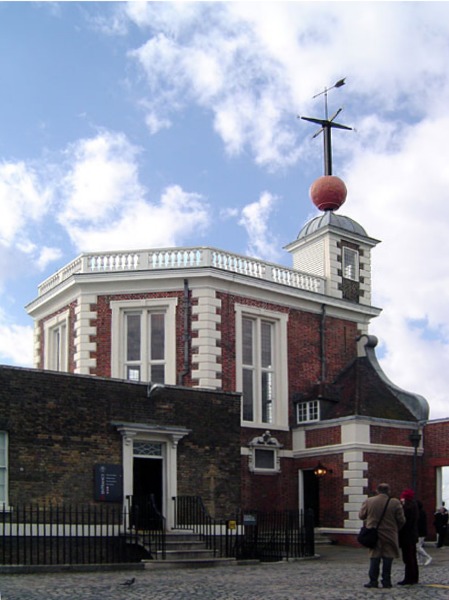
The Royal Observatory, Greenwich (ROG; known as the Old Royal Observatory from 1957 to 1998, when the working Royal Greenwich Observatory, RGO, temporarily moved south from Greenwich to Herstmonceux) is an observatory situated on a hill in Greenwich Park in south east London, overlooking the River Thames to the north. It played a major role in the history of astronomy and navigation, and because the Prime Meridian passed through it, it gave its name to Greenwich Mean Time, the precursor to today's Coordinated Universal Time (UTC). The ROG has the IAU observatory code of 000, the first in the list. ROG, the National Maritime Museum, the Queen's House and the clipper ship Cutty Sark are collectively designated Royal Museums Greenwich.
The observatory was commissioned in 1675 by King Charles II, with the foundation stone being laid on 10 August. The old hilltop site of Greenwich Castle was chosen by Sir Christopher Wren, a former Savilian Professor of Astronomy; as Greenwich Park was a royal estate, no new land needed to be bought. At that time the king also created the position of Astronomer Royal, to serve as the director of the observatory and to "apply himself with the most exact care and diligence to the rectifying of the tables of the motions of the heavens, and the places of the fixed stars, so as to find out the so much desired longitude of places for the perfecting of the art of navigation." He appointed John Flamsteed as the first Astronomer Royal. The building was completed in the summer of 1676. The building was often called "Flamsteed House", in reference to its first occupant.
The scientific work of the observatory was relocated elsewhere in stages in the first half of the 20th century, and the Greenwich site is now maintained almost exclusively as a museum, although the AMAT telescope became operational for astronomical research in 2018.

Chronology
- 1675 – 22 June, Royal Observatory founded by King Charles II.
- 1675 – 10 August, construction began.
- 1714 Longitude Act established the Board of Longitude and Longitude rewards. The Astronomer Royal was, until the Board was dissolved in 1828, always an ex officio Commissioner of Longitude.
- 1767 The fifth Astronomer Royal Nevil Maskelyne began publication of The Nautical Almanac, based on observations made at the Observatory.
- 1818 Oversight of the Royal Observatory was transferred from the Board of Ordnance to the Board of Admiralty; at that time the observatory was charged with maintaining the Royal Navy's marine chronometers.
- 1833 Daily time signals began, marked by dropping a time ball.
- 1838 – Sheepshanks equatorial, a 6.7 inches (170 mm) aperture refracting telescope installed.
- 1852 Time signals were distributed through telegraph lines.
- 1884 The International Meridian Conference in Washington D.C. decides that the Greenwich Prime Meridian should be the Prime meridian for the whole world, which it remains for a century.
- 1893 – The 28-inch Great refractor installed.
- 1899 The New Physical Observatory (now known as the South Building) was completed.
- 1924 Hourly time signals (Greenwich Time Signal) from the Royal Observatory were first broadcast on 5 February.
- 1931 Yapp telescope ordered.
- 1948 Office of the Astronomer Royal was moved to Herstmonceux in East Sussex.
- 1957 Royal Observatory completed its move to Herstmonceux, becoming the Royal Greenwich Observatory (RGO). The Greenwich site was renamed the Old Royal Observatory.
- 1984 The IERS Reference Meridian replaces the Greenwich Meridian as the Prime Meridian for the world. Its location is closely related to its predecessor, but runs approximately 102 metres east of it.
- 1990 RGO moved to Cambridge.
- 1998 RGO closed. Greenwich site was returned to its original name, the Royal Observatory, Greenwich, and was made part of the National Maritime Museum.
- 2011 The Greenwich museums, including the ROG, became collectively the Royal Museums Greenwich.
in Wikipédia



Sem comentários:
Enviar um comentário