Mostrar mensagens com a etiqueta Sylacauga. Mostrar todas as mensagens

domingo, novembro 30, 2025

O meteorito Sylacauga caiu na Terra há 71 anos - e em cima de um ser humano...!

undefined

   
The Sylacauga meteorite fell on November 30, 1954, at 14:46 local time (18:46 UT) in Oak Grove, Alabama, near Sylacauga. It is commonly called the Hodges meteorite because a fragment of it struck Ann Elizabeth Hodges (1920–1972).

Importance
The Sylacauga meteorite is the first documented extraterrestrial object to have injured a human being in the USA. The grapefruit-sized fragment crashed through the roof of a frame house, bounced off a large wooden console radio, and hit Hodges while she napped on a couch. The 34-year-old woman was badly bruised on one side of her body but able to walk. The event received worldwide publicity.
The Sylacauga meteorite is not the only extraterrestrial object to have struck a human. A manuscript published at Tortona, Italy, in 1677 tells of a Milanese friar who was killed by a meteorite. In 1992 a small meteorite fragment (3 g) hit a young Ugandan boy in Mbale, but it had been slowed down by a tree and did not cause any injury.

Fireball
The meteor made a fireball visible from three states as it streaked through the atmosphere, even though it fell early in the afternoon. There were also indications of an air blast, as witnesses described hearing "explosions or loud booms".

Following events
The United States Air Force sent a helicopter to take the meteorite. Eugene Hodges, the husband of the woman who was struck, hired a lawyer to get it back. The Hodges' landlord, Bertie Guy, also claimed it, wanting to sell it to cover the damage to the house. There were offers of up to $5,000 for the meteorite. By the time it was returned to the Hodgeses, over a year later, public attention had diminished, and they were unable to find a buyer willing to pay.
Ann Hodges was uncomfortable with the public attention and the stress of the dispute over ownership of the meteorite. She donated it to the Alabama Museum of Natural History in 1956.
The day after the fall, local African-American farmer Julius McKinney came upon the second-largest fragment from the same meteorite. An Indianapolis-based lawyer purchased it for the Smithsonian Institution. The McKinney family was able to use the money to purchase a car, new house, and land.

Fragments
Upon the entry within the atmosphere the Sylacauga meteorite fragmented in at least 3 pieces:
  • The Hodges fragment (3.86 kilograms - 33°11′18.1″N 86°17′40.2″W) struck Ann Elizabeth Hodges.
  • The McKinney fragment (1.68 kilograms - 33°13′08.4″N 86°17′20.7″W) was found the next day December 1, 1954 by Julius Kempis McKinney, an African-American farmer, who sold the meteorite fragment he found to purchase a house and more land.
  • A third fragment is believed to have impacted somewhere near Childersburg (a few km north-west of Oak Grove).

Classification
The Sylacauga meteorite is classified as an ordinary chondrite of H4 group.

Orbit
The meteoroid came in on the sunward side of the Earth, so when it hit it had passed the perihelion and was travelling outward from the Sun. Considering the orbit estimations, the best candidate as parent body is 1685 Toro.


Moody Jacobs shows a giant bruise on the side and hip of his patient, Ann Hodges, in 1954, after she was struck by a meteorite
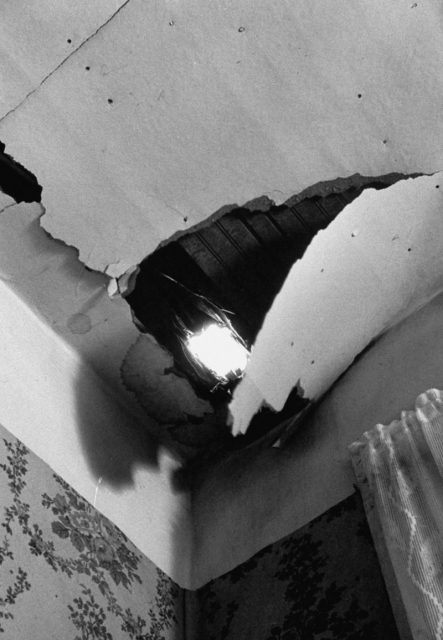

Interior view of a hole in the ceiling of the rental home where Ann Elizabeth Hodges and her husband lived, through which she was struck by a falling meteorite, Sylacauga, Alabama
domingo, agosto 24, 2025

Artigo a recordar que os humanos podem ser atingidos por meteoritos...

Salva pelo rádio: quando Ann Hodges foi atingida por um meteorito


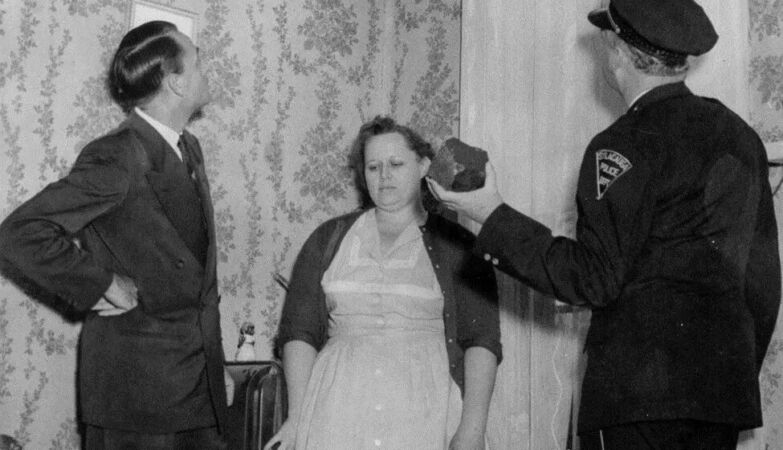
Polícia com meteorito na mão e com Ann Hodges à chegada da casa após a queda do meteorito


Só aconteceu duas vezes na história, mas Ann foi a primeira: é mais provável ser atingido por um tornado, um raio e um furacão ao mesmo tempo do que ser atingido por um meteorito.

Foi há pouco mais de 70 anos que Ann Hodges, de Sylacauga, Alabama, nos EUA, tornou-se a primeira pessoa documentada a ser atingida por um meteorito.

A mulher, de 34 anos, estava a tirar uma sesta na sala de estar quando o evento bizarro aconteceu, atingindo não só a sua anca, mas toda uma nação com um golpe de curiosidade e fascínio.

Enquanto dormia, Ann foi atingida pelo fragmento do meteorito de Sylacauga, que tinha, milissegundos antes, atravessado o telhado da casa que alugava em Oak Grove, naquele 30 de novembro de 1954. 

undefined 


 undefined


A mulher ficou com um enorme hematoma na zona da anca e coxa, mas felizmente saiu ilesa de lesões mais graves. A manta que a cobria naquele sono amparou o objeto espacial que rasgou os céus e o seu telhado, mas foi o seu rádio, que absorveu o primeiro impacto do meteorito, que a salvou e evitou ferimentos mais sérios.

Ouvindo um estrondo e o grito da filha, a mãe de Hodges, que se encontrava noutra divisão, correu sem saber de imediato (obviamente) o que tinha acontecido. Quem poderia afinal sequer sonhar com isto?

O meteorito, com 3,85 kg, foi mais tarde classificado como condrito — um meteorito rochoso composto por ferro e níquel — com cerca de 4,5 mil milhões de anos, datando da formação do sistema solar. Os especialistas acreditam que se terá originado a partir do asteroide 1685 Toro, antes de entrar na atmosfera terrestre, recorda o Business Insider.

À medida que descia, o meteorito fragmentou-se: uma parte atingiu Hodges e outra foi descoberta alguns quilómetros mais longe por um agricultor, Julius Kempis McKinney, que a vendeu e usou o dinheiro para comprar uma casa e um carro.

A notícia do impacto espalhou-se rapidamente por Sylacauga, por telefone e boca a boca. Num instante, vizinhos juntaqam-se à polícia na casa de Ann Hodges. Foi chamado um médico, embora Hodges não estivesse gravemente ferida, e as autoridades, incluindo a Força Aérea, inicialmente confiscaram a rocha para determinar se se tratava de um meteorito ou de um disco voador alienígena.

Confirmado como meteorito, Hodges teve inicialmente problemas legais devido aos danos na propriedade que era alugada. O senhorio alegou que o meteorito lhe pertencia, por ter caído na sua propriedade. Mais tarde, concordou em receber 500 dólares, permitindo que Hodges mantivesse o meteorito na sua posse, algo que viria a mudar mais tarde.

O extraordinário evento transformou Hodges numa celebridade temporária nos EUA. Apareceu no famoso programa de televisão de Garry Moore, “I’ve Got a Secret”, e recebeu correspondência de fãs de diversos grupos, embora tenha preferido manter a sua privacidade. Com o tempo, Hodges doou o meteorito ao Alabama Museum of Natural History, pedindo apenas o reembolso das despesas com o advogado.

O incidente também afetou o seu casamento: o marido Eugene tentou, sem sucesso, vender o meteorito, levando ao divórcio do casal em 1964.

Hodges morreria em 1972, aos 52 anos, vítima de insuficiência renal. Mas a história, apesar de pouco conhecida, continua a fascinar o mundo. Mary Beth Prondzinski, do Alabama Museum of Natural History, descreveu-a como “uma daquelas lendas locais que poucas pessoas conhecem”, e lembra que o meteorito está atualmente avaliado em mais de um milhão de dólares. Os cientistas destacam a raridade destes eventos: o astrónomo Michael Reynolds, do Florida State College, disse à National Geographic que é mais provável ser atingido por um tornado, um raio e um furacão ao mesmo tempo do que ser atingido por um meteorito.

No dia 6 de julho de 2023 aconteceu, pela segunda vez, também a uma mulher: estava a tomar café com uma amiga no pátio da sua casa em Schirmeck, no nordeste de França, quando foi inesperadamente atingida por um meteorito.

Em junho deste ano, um homem em McDonough, Geórgia, quase se juntou ao raro clube de vítimas de meteoritos quando fragmentos de um meteorito atravessaram o seu telhado, amassaram o chão e quase o atingiram por cerca de quatro metros. Investigadores da University of Georgia relataram que o meteorito provavelmente se formou há 4,56 mil milhões de anos, anterior à Terra, produzindo um efeito sónico percetível no impacto.


in ZAP 

sábado, novembro 30, 2024

Há setenta nos o meteorito Sylacauga caiu na Terra - e em cima de um humano...!

A slice of the meteorite, the National Museum of Natural History, the Smithsonian, DC
   
The Sylacauga meteorite fell on November 30, 1954, at 14:46 local time (18:46 UT) in Oak Grove, Alabama, near Sylacauga. It is commonly called the Hodges meteorite because a fragment of it struck Ann Elizabeth Hodges (1920–1972).

Importance
The Sylacauga meteorite is the first documented extraterrestrial object to have injured a human being in the USA. The grapefruit-sized fragment crashed through the roof of a frame house, bounced off a large wooden console radio, and hit Hodges while she napped on a couch. The 34-year-old woman was badly bruised on one side of her body but able to walk. The event received worldwide publicity.
The Sylacauga meteorite is not the only extraterrestrial object to have struck a human. A manuscript published at Tortona, Italy, in 1677 tells of a Milanese friar who was killed by a meteorite. In 1992 a small meteorite fragment (3 g) hit a young Ugandan boy in Mbale, but it had been slowed down by a tree and did not cause any injury.

Fireball
The meteor made a fireball visible from three states as it streaked through the atmosphere, even though it fell early in the afternoon. There were also indications of an air blast, as witnesses described hearing "explosions or loud booms".

Following events
The United States Air Force sent a helicopter to take the meteorite. Eugene Hodges, the husband of the woman who was struck, hired a lawyer to get it back. The Hodges' landlord, Bertie Guy, also claimed it, wanting to sell it to cover the damage to the house. There were offers of up to $5,000 for the meteorite. By the time it was returned to the Hodgeses, over a year later, public attention had diminished, and they were unable to find a buyer willing to pay.
Ann Hodges was uncomfortable with the public attention and the stress of the dispute over ownership of the meteorite. She donated it to the Alabama Museum of Natural History in 1956.
The day after the fall, local African-American farmer Julius McKinney came upon the second-largest fragment from the same meteorite. An Indianapolis-based lawyer purchased it for the Smithsonian Institution. The McKinney family was able to use the money to purchase a car, new house, and land.

Fragments
Upon the entry within the atmosphere the Sylacauga meteorite fragmented in at least 3 pieces:
  • The Hodges fragment (3.86 kilograms - 33°11′18.1″N 86°17′40.2″W) struck Ann Elizabeth Hodges.
  • The McKinney fragment (1.68 kilograms - 33°13′08.4″N 86°17′20.7″W) was found the next day December 1, 1954 by Julius Kempis McKinney, an African-American farmer, who sold the meteorite fragment he found to purchase a house and more land.
  • A third fragment is believed to have impacted somewhere near Childersburg (a few km north-west of Oak Grove).

Classification
The Sylacauga meteorite is classified as an ordinary chondrite of H4 group.

Orbit
The meteoroid came in on the sunward side of the Earth, so when it hit it had passed the perihelion and was travelling outward from the Sun. Considering the orbit estimations, the best candidate as parent body is 1685 Toro.


Moody Jacobs shows a giant bruise on the side and hip of his patient, Ann Hodges, in 1954, after she was struck by a meteorite


Interior view of a hole in the ceiling of the rental home where Ann Elizabeth Hodges and her husband lived, through which she was struck by a falling meteorite, Sylacauga, Alabama

quinta-feira, novembro 30, 2023

O meteorito Sylacauga caiu (em cima de um humano) há 69 anos...!

A slice of the meteorite, the National Museum of Natural History, the Smithsonian, DC
   
The Sylacauga meteorite fell on November 30, 1954, at 14:46 local time (18:46 UT) in Oak Grove, Alabama, near Sylacauga. It is commonly called the Hodges meteorite because a fragment of it struck Ann Elizabeth Hodges (1920–1972).

Importance
The Sylacauga meteorite is the first documented extraterrestrial object to have injured a human being in the USA. The grapefruit-sized fragment crashed through the roof of a frame house, bounced off a large wooden console radio, and hit Hodges while she napped on a couch. The 34-year-old woman was badly bruised on one side of her body but able to walk. The event received worldwide publicity.
The Sylacauga meteorite is not the only extraterrestrial object to have struck a human. A manuscript published at Tortona, Italy, in 1677 tells of a Milanese friar who was killed by a meteorite. In 1992 a small meteorite fragment (3 g) hit a young Ugandan boy in Mbale, but it had been slowed down by a tree and did not cause any injury.

Fireball
The meteor made a fireball visible from three states as it streaked through the atmosphere, even though it fell early in the afternoon. There were also indications of an air blast, as witnesses described hearing "explosions or loud booms".

Following events
The United States Air Force sent a helicopter to take the meteorite. Eugene Hodges, the husband of the woman who was struck, hired a lawyer to get it back. The Hodges' landlord, Bertie Guy, also claimed it, wanting to sell it to cover the damage to the house. There were offers of up to $5,000 for the meteorite. By the time it was returned to the Hodgeses, over a year later, public attention had diminished, and they were unable to find a buyer willing to pay.
Ann Hodges was uncomfortable with the public attention and the stress of the dispute over ownership of the meteorite. She donated it to the Alabama Museum of Natural History in 1956.
The day after the fall, local African-American farmer Julius McKinney came upon the second-largest fragment from the same meteorite. An Indianapolis-based lawyer purchased it for the Smithsonian Institution. The McKinney family was able to use the money to purchase a car, new house, and land.

Fragments
Upon the entry within the atmosphere the Sylacauga meteorite fragmented in at least 3 pieces:
  • The Hodges fragment (3.86 kilograms - 33°11′18.1″N 86°17′40.2″W) struck Ann Elizabeth Hodges.
  • The McKinney fragment (1.68 kilograms - 33°13′08.4″N 86°17′20.7″W) was found the next day December 1, 1954 by Julius Kempis McKinney, an African-American farmer, who sold the meteorite fragment he found to purchase a house and more land.
  • A third fragment is believed to have impacted somewhere near Childersburg (a few km north-west of Oak Grove).

Classification
The Sylacauga meteorite is classified as an ordinary chondrite of H4 group.

Orbit
The meteoroid came in on the sunward side of the Earth, so when it hit it had passed the perihelion and was travelling outward from the Sun. Considering the orbit estimations, the best candidate as parent body is 1685 Toro.


Moody Jacobs shows a giant bruise on the side and hip of his patient, Ann Hodges, in 1954, after she was struck by a meteorite


Interior view of a hole in the ceiling of the rental home where Ann Elizabeth Hodges and her husband lived, through which she was struck by a falling meteorite, Sylacauga, Alabama

quarta-feira, novembro 30, 2022

O meteorito Sylacauga caiu (em cima de um humano...!) há 68 anos

A slice of the meteorite, the National Museum of Natural History, the Smithsonian, DC
   
The Sylacauga meteorite fell on November 30, 1954, at 14:46 local time (18:46 UT) in Oak Grove, Alabama, near Sylacauga. It is commonly called the Hodges meteorite because a fragment of it struck Ann Elizabeth Hodges (1920–1972).

Importance
The Sylacauga meteorite is the first documented extraterrestrial object to have injured a human being in the USA. The grapefruit-sized fragment crashed through the roof of a frame house, bounced off a large wooden console radio, and hit Hodges while she napped on a couch. The 34-year-old woman was badly bruised on one side of her body but able to walk. The event received worldwide publicity.
The Sylacauga meteorite is not the only extraterrestrial object to have struck a human. A manuscript published at Tortona, Italy, in 1677 tells of a Milanese friar who was killed by a meteorite. In 1992 a small meteorite fragment (3 g) hit a young Ugandan boy in Mbale, but it had been slowed down by a tree and did not cause any injury.

Fireball
The meteor made a fireball visible from three states as it streaked through the atmosphere, even though it fell early in the afternoon. There were also indications of an air blast, as witnesses described hearing "explosions or loud booms".

Following events
The United States Air Force sent a helicopter to take the meteorite. Eugene Hodges, the husband of the woman who was struck, hired a lawyer to get it back. The Hodges' landlord, Bertie Guy, also claimed it, wanting to sell it to cover the damage to the house. There were offers of up to $5,000 for the meteorite. By the time it was returned to the Hodgeses, over a year later, public attention had diminished, and they were unable to find a buyer willing to pay.
Ann Hodges was uncomfortable with the public attention and the stress of the dispute over ownership of the meteorite. She donated it to the Alabama Museum of Natural History in 1956.
The day after the fall, local African-American farmer Julius McKinney came upon the second-largest fragment from the same meteorite. An Indianapolis-based lawyer purchased it for the Smithsonian Institution. The McKinney family was able to use the money to purchase a car, new house, and land.

Fragments
Upon the entry within the atmosphere the Sylacauga meteorite fragmented in at least 3 pieces:
  • The Hodges fragment (3.86 kilograms - 33°11′18.1″N 86°17′40.2″W) struck Ann Elizabeth Hodges.
  • The McKinney fragment (1.68 kilograms - 33°13′08.4″N 86°17′20.7″W) was found the next day December 1, 1954 by Julius Kempis McKinney, an African-American farmer, who sold the meteorite fragment he found to purchase a house and more land.
  • A third fragment is believed to have impacted somewhere near Childersburg (a few km north-west of Oak Grove).

Classification
The Sylacauga meteorite is classified as an ordinary chondrite of H4 group.

Orbit
The meteoroid came in on the sunward side of the Earth, so when it hit it had passed the perihelion and was travelling outward from the Sun. Considering the orbit estimations, the best candidate as parent body is 1685 Toro.


Ed Howard, then Sylacauga mayor, Ann Hodges and then Sylacauga Police Chief W.D. Ashcraft pose with a meteorite underneath the point where it crashed through Hodges' house in 1954

Moody Jacobs shows a giant bruise on the side and hip of his patient, Ann Hodges, in 1954, after she was struck by a meteorite


Interior view of a hole in the ceiling of the rental home where Ann Elizabeth Hodges and her husband lived, through which she was struck by a falling meteorite, Sylacauga, Alabama

terça-feira, novembro 30, 2021

O meteorito Sylacauga caiu em cima de um humano há 67 anos!

A slice of the meteorite, the National Museum of Natural History, the Smithsonian, DC
   
The Sylacauga meteorite fell on November 30, 1954, at 14:46 local time (18:46 UT) in Oak Grove, Alabama, near Sylacauga. It is commonly called the Hodges meteorite because a fragment of it struck Ann Elizabeth Hodges (1920–1972).

Importance
The Sylacauga meteorite is the first documented extraterrestrial object to have injured a human being in the USA. The grapefruit-sized fragment crashed through the roof of a frame house, bounced off a large wooden console radio, and hit Hodges while she napped on a couch. The 34-year-old woman was badly bruised on one side of her body but able to walk. The event received worldwide publicity.
The Sylacauga meteorite is not the only extraterrestrial object to have struck a human. A manuscript published at Tortona, Italy, in 1677 tells of a Milanese friar who was killed by a meteorite. In 1992 a small meteorite fragment (3 g) hit a young Ugandan boy in Mbale, but it had been slowed down by a tree and did not cause any injury.

Fireball
The meteor made a fireball visible from three states as it streaked through the atmosphere, even though it fell early in the afternoon. There were also indications of an air blast, as witnesses described hearing "explosions or loud booms".

Following events
The United States Air Force sent a helicopter to take the meteorite. Eugene Hodges, the husband of the woman who was struck, hired a lawyer to get it back. The Hodges' landlord, Bertie Guy, also claimed it, wanting to sell it to cover the damage to the house. There were offers of up to $5,000 for the meteorite. By the time it was returned to the Hodgeses, over a year later, public attention had diminished, and they were unable to find a buyer willing to pay.
Ann Hodges was uncomfortable with the public attention and the stress of the dispute over ownership of the meteorite. She donated it to the Alabama Museum of Natural History in 1956.
The day after the fall, local African-American farmer Julius McKinney came upon the second-largest fragment from the same meteorite. An Indianapolis-based lawyer purchased it for the Smithsonian Institution. The McKinney family was able to use the money to purchase a car, new house, and land.

Fragments
Upon the entry within the atmosphere the Sylacauga meteorite fragmented in at least 3 pieces:
  • The Hodges fragment (3.86 kilograms - 33°11′18.1″N 86°17′40.2″W) struck Ann Elizabeth Hodges.
  • The McKinney fragment (1.68 kilograms - 33°13′08.4″N 86°17′20.7″W) was found the next day December 1, 1954 by Julius Kempis McKinney, an African-American farmer, who sold the meteorite fragment he found to purchase a house and more land.
  • A third fragment is believed to have impacted somewhere near Childersburg (a few km north-west of Oak Grove).

Classification
The Sylacauga meteorite is classified as an ordinary chondrite of H4 group.

Orbit
The meteoroid came in on the sunward side of the Earth, so when it hit it had passed the perihelion and was travelling outward from the Sun. Considering the orbit estimations, the best candidate as parent body is 1685 Toro.


Ed Howard, then Sylacauga mayor, Ann Hodges and then Sylacauga Police Chief W.D. Ashcraft pose with a meteorite underneath the point where it crashed through Hodges' house in 1954

Moody Jacobs shows a giant bruise on the side and hip of his patient, Ann Hodges, in 1954, after she was struck by a meteorite


Interior view of a hole in the ceiling of the rental home where Ann Elizabeth Hodges and her husband lived, through which she was struck by a falling meteorite, Sylacauga, Alabama

segunda-feira, novembro 30, 2020

O meteorito Sylacauga caiu, há 66 anos, em cima de um humano!

A slice of the meteorite, the National Museum of Natural History, the Smithsonian, DC
   
The Sylacauga meteorite fell on November 30, 1954, at 14:46 local time (18:46 UT) in Oak Grove, Alabama, near Sylacauga. It is commonly called the Hodges meteorite because a fragment of it struck Ann Elizabeth Hodges (1920–1972).

Importance
The Sylacauga meteorite is the first documented extraterrestrial object to have injured a human being in the USA. The grapefruit-sized fragment crashed through the roof of a frame house, bounced off a large wooden console radio, and hit Hodges while she napped on a couch. The 34-year-old woman was badly bruised on one side of her body but able to walk. The event received worldwide publicity.
The Sylacauga meteorite is not the only extraterrestrial object to have struck a human. A manuscript published at Tortona, Italy, in 1677 tells of a Milanese friar who was killed by a meteorite. In 1992 a small meteorite fragment (3 g) hit a young Ugandan boy in Mbale, but it had been slowed down by a tree and did not cause any injury.

Fireball
The meteor made a fireball visible from three states as it streaked through the atmosphere, even though it fell early in the afternoon. There were also indications of an air blast, as witnesses described hearing "explosions or loud booms".

Following events
The United States Air Force sent a helicopter to take the meteorite. Eugene Hodges, the husband of the woman who was struck, hired a lawyer to get it back. The Hodges' landlord, Bertie Guy, also claimed it, wanting to sell it to cover the damage to the house. There were offers of up to $5,000 for the meteorite. By the time it was returned to the Hodgeses, over a year later, public attention had diminished, and they were unable to find a buyer willing to pay.
Ann Hodges was uncomfortable with the public attention and the stress of the dispute over ownership of the meteorite. She donated it to the Alabama Museum of Natural History in 1956.
The day after the fall, local African-American farmer Julius McKinney came upon the second-largest fragment from the same meteorite. An Indianapolis-based lawyer purchased it for the Smithsonian Institution. The McKinney family was able to use the money to purchase a car, new house, and land.

Fragments
Upon the entry within the atmosphere the Sylacauga meteorite fragmented in at least 3 pieces:
  • The Hodges fragment (3.86 kilograms - 33°11′18.1″N 86°17′40.2″W) struck Ann Elizabeth Hodges.
  • The McKinney fragment (1.68 kilograms - 33°13′08.4″N 86°17′20.7″W) was found the next day December 1, 1954 by Julius Kempis McKinney, an African-American farmer, who sold the meteorite fragment he found to purchase a house and more land.
  • A third fragment is believed to have impacted somewhere near Childersburg (a few km north-west of Oak Grove).

Classification
The Sylacauga meteorite is classified as an ordinary chondrite of H4 group.

Orbit
The meteoroid came in on the sunward side of the Earth, so when it hit it had passed the perihelion and was travelling outward from the Sun. Considering the orbit estimations, the best candidate as parent body is 1685 Toro.


Ed Howard, then Sylacauga mayor, Ann Hodges and then Sylacauga Police Chief W.D. Ashcraft pose with a meteorite underneath the point where it crashed through Hodges' house in 1954

Moody Jacobs shows a giant bruise on the side and hip of his patient, Ann Hodges, in 1954, after she was struck by a meteorite


Interior view of a hole in the ceiling of the rental home where Ann Elizabeth Hodges and her husband lived, through which she was struck by a falling meteorite, Sylacauga, Alabama

sábado, novembro 30, 2019

O meteorito Sylacauga caiu há 65 anos - em cima de um humano!

A slice of the meteorite, the National Museum of Natural History, the Smithsonian, DC

The Sylacauga meteorite fell on November 30, 1954, at 14:46 local time (18:46 UT) in Oak Grove, Alabama, near Sylacauga. It is commonly called the Hodges meteorite because a fragment of it struck Ann Elizabeth Hodges (1920–1972).

Importance
The Sylacauga meteorite is the first documented extraterrestrial object to have injured a human being in the USA. The grapefruit-sized fragment crashed through the roof of a frame house, bounced off a large wooden console radio, and hit Hodges while she napped on a couch. The 34-year-old woman was badly bruised on one side of her body but able to walk. The event received worldwide publicity.
The Sylacauga meteorite is not the only extraterrestrial object to have struck a human. A manuscript published at Tortona, Italy, in 1677 tells of a Milanese friar who was killed by a meteorite. In 1992 a small meteorite fragment (3 g) hit a young Ugandan boy in Mbale, but it had been slowed down by a tree and did not cause any injury.

Fireball
The meteor made a fireball visible from three states as it streaked through the atmosphere, even though it fell early in the afternoon. There were also indications of an air blast, as witnesses described hearing "explosions or loud booms".

Following events
The United States Air Force sent a helicopter to take the meteorite. Eugene Hodges, the husband of the woman who was struck, hired a lawyer to get it back. The Hodges' landlord, Bertie Guy, also claimed it, wanting to sell it to cover the damage to the house. There were offers of up to $5,000 for the meteorite. By the time it was returned to the Hodgeses, over a year later, public attention had diminished, and they were unable to find a buyer willing to pay.
Ann Hodges was uncomfortable with the public attention and the stress of the dispute over ownership of the meteorite. She donated it to the Alabama Museum of Natural History in 1956.
The day after the fall, local African-American farmer Julius McKinney came upon the second-largest fragment from the same meteorite. An Indianapolis-based lawyer purchased it for the Smithsonian Institution. The McKinney family was able to use the money to purchase a car, new house, and land.

Fragments
Upon the entry within the atmosphere the Sylacauga meteorite fragmented in at least 3 pieces:
  • The Hodges fragment (3.86 kilograms - 33°11′18.1″N 86°17′40.2″W) struck Ann Elizabeth Hodges.
  • The McKinney fragment (1.68 kilograms - 33°13′08.4″N 86°17′20.7″W) was found the next day December 1, 1954 by Julius Kempis McKinney, an African-American farmer, who sold the meteorite fragment he found to purchase a house and more land.
  • A third fragment is believed to have impacted somewhere near Childersburg (a few km north-west of Oak Grove).

Classification
The Sylacauga meteorite is classified as an ordinary chondrite of H4 group.

Orbit
The meteoroid came in on the sunward side of the Earth, so when it hit it had passed the perihelion and was travelling outward from the Sun. Considering the orbit estimations, the best candidate as parent body is 1685 Toro.


Ed Howard, then Sylacauga mayor, Ann Hodges and then Sylacauga Police Chief W.D. Ashcraft pose with a meteorite underneath the point where it crashed through Hodges' house in 1954

Moody Jacobs shows a giant bruise on the side and hip of his patient, Ann Hodges, in 1954, after she was struck by a meteorite


Interior view of a hole in the ceiling of the rental home where Ann Elizabeth Hodges and her husband lived, through which she was struck by a falling meteorite, Sylacauga, Alabama

domingo, novembro 30, 2014

Há 60 anos um meteorito atingiu um ser humano nos Estados Unidos

A slice of the meteorite, the National Museum of Natural History, the Smithsonian, DC

The Sylacauga meteorite fell on November 30, 1954, at 14:46 local time (18:46 UT) in Oak Grove, Alabama, near Sylacauga. It is commonly called the Hodges meteorite because a fragment of it struck Ann Elizabeth Hodges (1920–1972).

Importance
The Sylacauga meteorite is the first documented extraterrestrial object to have injured a human being in the USA. The grapefruit-sized fragment crashed through the roof of a frame house, bounced off a large wooden console radio, and hit Hodges while she napped on a couch. The 34-year-old woman was badly bruised on one side of her body but able to walk. The event received worldwide publicity.
The Sylacauga meteorite is not the only extraterrestrial object to have struck a human. A manuscript published at Tortona, Italy, in 1677 tells of a Milanese friar who was killed by a meteorite. In 1992 a small meteorite fragment (3 g) hit a young Ugandan boy in Mbale, but it had been slowed down by a tree and did not cause any injury.

Fireball
The meteor made a fireball visible from three states as it streaked through the atmosphere, even though it fell early in the afternoon. There were also indications of an air blast, as witnesses described hearing "explosions or loud booms".

Following events
The United States Air Force sent a helicopter to take the meteorite. Eugene Hodges, the husband of the woman who was struck, hired a lawyer to get it back. The Hodges' landlord, Bertie Guy, also claimed it, wanting to sell it to cover the damage to the house. There were offers of up to $5,000 for the meteorite. By the time it was returned to the Hodgeses, over a year later, public attention had diminished, and they were unable to find a buyer willing to pay.
Ann Hodges was uncomfortable with the public attention and the stress of the dispute over ownership of the meteorite. She donated it to the Alabama Museum of Natural History in 1956.
The day after the fall, local African-American farmer Julius McKinney came upon the second-largest fragment from the same meteorite. An Indianapolis-based lawyer purchased it for the Smithsonian Institution. The McKinney family was able to use the money to purchase a car, new house, and land.

Fragments
Upon the entry within the atmosphere the Sylacauga meteorite fragmented in at least 3 pieces:

  • The Hodges fragment (3.86 kilograms - 33°11′18.1″N 86°17′40.2″W) struck Ann Elizabeth Hodges.
  • The McKinney fragment (1.68 kilograms - 33°13′08.4″N 86°17′20.7″W) was found the next day December 1, 1954 by Julius Kempis McKinney, an African-American farmer, who sold the meteorite fragment he found to purchase a house and more land.
  • A third fragment is believed to have impacted somewhere near Childersburg (a few km north-west of Oak Grove).


Classification
The Sylacauga meteorite is classified as an ordinary chondrite of H4 group.

Orbit
The meteoroid came in on the sunward side of the Earth, so when it hit it had passed the perihelion and was travelling outward from the Sun. Considering the orbit estimations, the best candidate as parent body is 1685 Toro.


Ed Howard, then Sylacauga mayor, Ann Hodges and then Sylacauga Police Chief W.D. Ashcraft pose with a meteorite underneath the point where it crashed through Hodges' house in 1954


Moody Jacobs shows a giant bruise on the side and hip of his patient, Ann Hodges, in 1954, after she was struck by a meteorite