quarta-feira, dezembro 03, 2025
A guerra que deu a independência ao Bangladesh começou há 54 anos
Postado por
Fernando Martins
às
00:54
0
bocas
Marcadores: Bangladesh, guerra, independência, Índia, Islão, Paquistão
quinta-feira, agosto 07, 2025
Rabindranath Tagore morreu há 84 anos...
Disse-me baixinho:
— Meu amor, olha-me nos olhos.
Ralhei-lhe, duramente, e disse-lhe:
— Vai-te embora.
Mas ele não foi.
Chegou ao pé de mim e agarrou-me as mãos...
Eu disse-lhe:
— Deixa-me.
Mas ele não deixou.
Encostou a cara ao meu ouvido.
Afastei-me um pouco,
fiquei a olhá-lo e disse-lhe:
— Não tens vergonha? Nem se moveu.
Os seus lábios roçaram a minha face.
Estremeci e disse-lhe:
— Como te atreves?
Mas ele não se envergonhou.
Prendeu-me uma flor no cabelo.
Eu disse-lhe:
— É inútil.
Mas ele não fez caso.
Tirou-me a grinalda do pescoço
e abalou.
Continuo a chorar,
e pergunto ao meu coração:
Porque é que ele não volta?
in O Coração da Primavera - Rabindranath Tagore
Postado por
Fernando Martins
às
08:40
0
bocas
Marcadores: Bangladesh, bengali, Índia, Índia Britânica, literatura, música, poesia, polímata, Prémio Nobel, Rabindranath Tagore
quinta-feira, abril 24, 2025
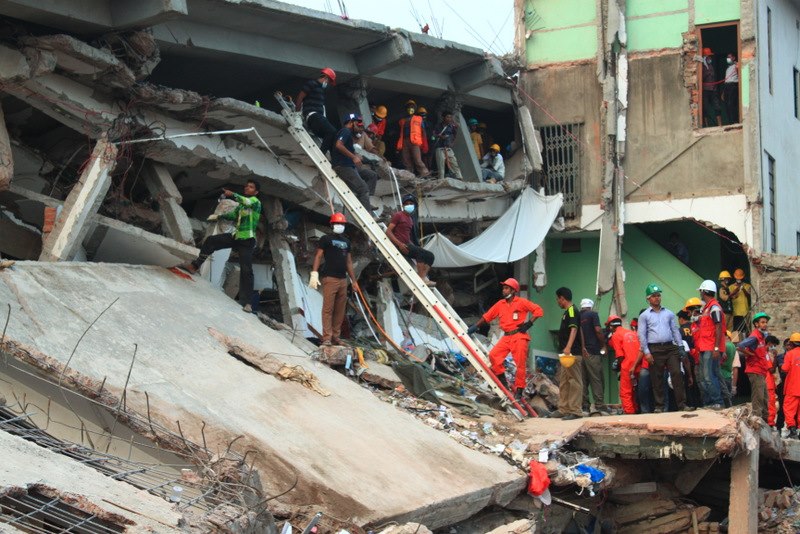
O desabamento de um prédio, no Bangladesh, matou mais de mil pessoas há doze anos...
The 2013 Rana Plaza factory collapse (also referred to as the Savar building collapse or the Collapse of Rana Plaza) was a structural failure that occurred on 24 April 2013 in the Savar Upazila of Dhaka District, Bangladesh, where an eight-story commercial building called Rana Plaza collapsed. The search for the dead ended on 13 May 2013 with a death toll of 1,134. Approximately 2,500 injured people were rescued from the building. It is considered the deadliest accidental structural failure in modern human history, the deadliest garment-factory disaster in history and the deadliest industrial accident in the history of Bangladesh.
The building contained clothing factories, a bank, apartments and several shops. The shops and the bank on the lower floors were immediately closed after cracks were discovered in the building. The building's owners ignored warnings to avoid using the building after cracks had appeared the day before. Garment workers were ordered to return the following day and the building collapsed during the morning rush-hour.On the morning of 24 April, there was a power outage and diesel generators on the top floor were started. The building collapsed at about 08:57 am BST, leaving only the ground floor intact. The Bangladesh Garment Manufacturers and Exporters Association president confirmed that 3,122 workers were in the building at the time of the collapse. One local resident described the scene as if "an earthquake had struck."
The United Nations' urban search and rescue coordination group – known as the International Search and Rescue Advisory Group, or INSARAG – offered assistance from its members, but the government of Bangladesh rejected this offer. The government made a statement suggesting that the area's local rescue emergency services were well equipped.[29] Before offering assistance to Bangladesh, the UN held consultations to assess the country's ability to mount an effective rescue operation and they reached the conclusion that they lacked that capability. Bangladeshi officials, desiring to take "face-saving" actions and protect national sensibilities, refused to accept the assistance offered to them by the UN. A large portion of the rescue operation consisted of inadequately equipped volunteers, many of whom had no protective clothing and wore sandals. Some buried workers drank their urine to survive the high temperatures, waiting to be saved. Not only was the Bangladeshi government accused of favoring national pride over those buried alive, but many relatives of those trapped in the debris criticized the government for trying to end the rescue mission prematurely.
One of the garment manufacturers' websites indicates that more than half of the victims were women, along with a number of their children who were in nursery facilities within the building. Bangladeshi Home Minister Muhiuddin Khan Alamgir confirmed that fire service personnel, police and military personnel were assisting with the rescue effort. Volunteer rescue workers used bolts of fabric to assist survivors to escape from the building. A national day of mourning was held on 25 April.
On 8 May, army spokesman Mir Rabbi said the army's attempt to recover more bodies from the rubble would continue for at least another week. On 10 May, 17 days after the collapse, a woman named Reshma was found and rescued alive and almost unhurt under the rubble.
Postado por
Fernando Martins
às
12:00
0
bocas
Marcadores: Bangladesh, Daca, desabamento de um prédio em Savar
sexta-feira, fevereiro 21, 2025
Hoje é o Dia Internacional da Língua Materna...!
O Dia Internacional da Língua Materna é uma comemoração mundial anual realizada em 21 de fevereiro para promover a consciencialização sobre a diversidade linguística e cultural e para promover o multilinguismo. Anunciado pela primeira vez pela UNESCO em 17 de novembro de 1999, foi formalmente reconhecido pela Assembleia Geral das Nações Unidas com a adoção da resolução 56/262 da ONU em 2002. O Dia da Língua Materna faz parte de uma iniciativa mais ampla "para promover o preservação e proteção de todas as línguas usadas pelos povos do mundo", conforme adotado pela Assembleia Geral da ONU em 16 de maio de 2007 na resolução 61/266 da ONU, que também estabeleceu 2008 como o Ano Internacional das Línguas. A ideia de comemorar o Dia Internacional da Língua Materna foi iniciativa do Bangladesh. No Bangladesh, o 21 de fevereiro é o aniversário do dia em que o povo do Bangladesh (então Paquistão Oriental) lutou pelo reconhecimento da língua bengali.
Língua Portuguesa
Última flor do Lácio, inculta e bela,
És, a um tempo, esplendor e sepultura:
Ouro nativo, que na ganga impura
A bruta mina entre os cascalhos vela…
Amo-te assim, desconhecida e obscura,
Tuba de alto clangor, lira singela,
Que tens o trom e o silvo da procela
E o arrolo da saudade e da ternura!
Amo o teu viço agreste e o teu aroma
De virgens selvas e de oceano largo!
Amo-te, ó rude e doloroso idioma,
Em que da voz materna ouvi: "meu filho!"
E em que Camões chorou, no exílio amargo,
O génio sem ventura e o amor sem brilho!
Olavo Bilac
Postado por
Fernando Martins
às
00:00
0
bocas
Marcadores: Bangladesh, Dia Internacional da Língua Materna, língua portuguesa, Olavo Bilac
terça-feira, janeiro 07, 2025
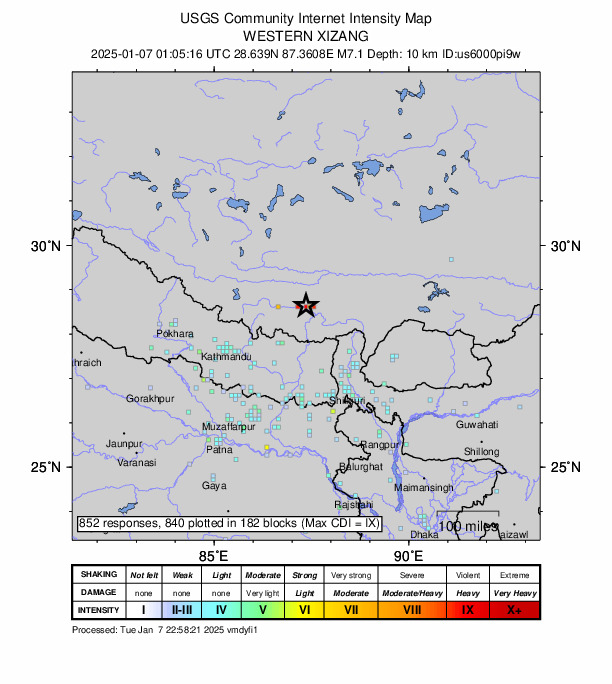
Terramoto no Tibete, também sentido no Nepal, Índia, Butão e Bangladesh...

The January 7, 2025, M7.1 earthquake in the southern Tibetan Plateau occurred as the result of normal faulting at shallow depths north of the boundary between the Eurasia and Indian plates. Focal mechanism solutions indicate that rupture occurred on a roughly north-south striking fault, dipping moderately to either to the east or to the west. Continental collision between the India and Eurasia plates drives uplift of the Himalayan Mountains. Focal mechanism solutions of this earthquake indicate this event was associated with a normal fault oriented roughly perpendicular to the plate boundary north of the Himalayan Mountains within the Eurasian plate.
While commonly plotted as points on maps, earthquakes of this size are more appropriately described as slip over a larger fault area. Normal faulting events of the size of the January 7, 2025 earthquake are typically about 45 km by 20 km (length x width).
The region near the India and Eurasia plate boundary has a history of large earthquakes. In the past century, there have been 10 earthquakes of magnitude 6 and greater within 250 km of the January 7, 2025, earthquake. This includes the 2015 M7.3 Nepal earthquake, located about 160 km to the southwest and the 1934 M8.0 earthquake, located about 160 to the south-southwest. The 2015 M7.3 Nepal earthquake was an aftershock of the April 25, 2015 M7.8 Nepal earthquake. This sequence of 2015 events resulted in 8,669 fatalities and widespread damage.
in USGS
terça-feira, dezembro 03, 2024
A guerra que deu a independência ao Bangladesh começou há 53 anos
Postado por
Fernando Martins
às
00:53
0
bocas
Marcadores: Bangladesh, guerra, independência, Índia, Islão, Paquistão
quarta-feira, agosto 07, 2024
Rabindranath Tagore morreu há oitenta e três anos...
Disse-me baixinho:
— Meu amor, olha-me nos olhos.
Ralhei-lhe, duramente, e disse-lhe:
— Vai-te embora.
Mas ele não foi.
Chegou ao pé de mim e agarrou-me as mãos...
Eu disse-lhe:
— Deixa-me.
Mas ele não deixou.
Encostou a cara ao meu ouvido.
Afastei-me um pouco,
fiquei a olhá-lo e disse-lhe:
— Não tens vergonha? Nem se moveu.
Os seus lábios roçaram a minha face.
Estremeci e disse-lhe:
— Como te atreves?
Mas ele não se envergonhou.
Prendeu-me uma flor no cabelo.
Eu disse-lhe:
— É inútil.
Mas ele não fez caso.
Tirou-me a grinalda do pescoço
e abalou.
Continuo a chorar,
e pergunto ao meu coração:
Porque é que ele não volta?
in O Coração da Primavera - Rabindranath Tagore
Postado por
Fernando Martins
às
08:30
0
bocas
Marcadores: Bangladesh, bengali, Índia, Índia Britânica, literatura, música, poesia, polímata, Prémio Nobel, Rabindranath Tagore
quarta-feira, abril 24, 2024
O desabamento de um prédio, no Bangladesh, matou mais de mil pessoas há onze anos...
The 2013 Rana Plaza factory collapse (also referred to as the Savar building collapse or the Collapse of Rana Plaza) was a structural failure that occurred on 24 April 2013 in the Savar Upazila of Dhaka District, Bangladesh, where an eight-story commercial building called Rana Plaza collapsed. The search for the dead ended on 13 May 2013 with a death toll of 1,134. Approximately 2,500 injured people were rescued from the building. It is considered the deadliest accidental structural failure in modern human history, the deadliest garment-factory disaster in history and the deadliest industrial accident in the history of Bangladesh.
The building contained clothing factories, a bank, apartments and several shops. The shops and the bank on the lower floors were immediately closed after cracks were discovered in the building. The building's owners ignored warnings to avoid using the building after cracks had appeared the day before. Garment workers were ordered to return the following day and the building collapsed during the morning rush-hour.On the morning of 24 April, there was a power outage and diesel generators on the top floor were started. The building collapsed at about 08:57 am BST, leaving only the ground floor intact. The Bangladesh Garment Manufacturers and Exporters Association president confirmed that 3,122 workers were in the building at the time of the collapse. One local resident described the scene as if "an earthquake had struck."
The United Nations' urban search and rescue coordination group – known as the International Search and Rescue Advisory Group, or INSARAG – offered assistance from its members, but the government of Bangladesh rejected this offer. The government made a statement suggesting that the area's local rescue emergency services were well equipped.[29] Before offering assistance to Bangladesh, the UN held consultations to assess the country's ability to mount an effective rescue operation and they reached the conclusion that they lacked that capability. Bangladeshi officials, desiring to take "face-saving" actions and protect national sensibilities, refused to accept the assistance offered to them by the UN. A large portion of the rescue operation consisted of inadequately equipped volunteers, many of whom had no protective clothing and wore sandals. Some buried workers drank their urine to survive the high temperatures, waiting to be saved. Not only was the Bangladeshi government accused of favoring national pride over those buried alive, but many relatives of those trapped in the debris criticized the government for trying to end the rescue mission prematurely.
One of the garment manufacturers' websites indicates that more than half of the victims were women, along with a number of their children who were in nursery facilities within the building. Bangladeshi Home Minister Muhiuddin Khan Alamgir confirmed that fire service personnel, police and military personnel were assisting with the rescue effort. Volunteer rescue workers used bolts of fabric to assist survivors to escape from the building. A national day of mourning was held on 25 April.
On 8 May, army spokesman Mir Rabbi said the army's attempt to recover more bodies from the rubble would continue for at least another week. On 10 May, 17 days after the collapse, a woman named Reshma was found and rescued alive and almost unhurt under the rubble.
Postado por
Fernando Martins
às
00:11
0
bocas
Marcadores: Bangladesh, Daca, desabamento de um prédio em Savar
quarta-feira, fevereiro 21, 2024
Hoje é o Dia Internacional da Língua Materna...!
O Dia Internacional da Língua Materna é uma comemoração mundial anual realizada em 21 de fevereiro para promover a consciencialização sobre a diversidade linguística e cultural e para promover o multilinguismo. Anunciado pela primeira vez pela UNESCO em 17 de novembro de 1999, foi formalmente reconhecido pela Assembleia Geral das Nações Unidas com a adoção da resolução 56/262 da ONU em 2002. O Dia da Língua Materna faz parte de uma iniciativa mais ampla "para promover o preservação e proteção de todas as línguas usadas pelos povos do mundo", conforme adotado pela Assembleia Geral da ONU em 16 de maio de 2007 na resolução 61/266 da ONU, que também estabeleceu 2008 como o Ano Internacional das Línguas. A ideia de comemorar o Dia Internacional da Língua Materna foi iniciativa do Bangladesh. No Bangladesh, o 21 de fevereiro é o aniversário do dia em que o povo do Bangladesh (então Paquistão Oriental) lutou pelo reconhecimento da língua bengali.
Língua Portuguesa
Última flor do Lácio, inculta e bela,
És, a um tempo, esplendor e sepultura:
Ouro nativo, que na ganga impura
A bruta mina entre os cascalhos vela…
Amo-te assim, desconhecida e obscura,
Tuba de alto clangor, lira singela,
Que tens o trom e o silvo da procela
E o arrolo da saudade e da ternura!
Amo o teu viço agreste e o teu aroma
De virgens selvas e de oceano largo!
Amo-te, ó rude e doloroso idioma,
Em que da voz materna ouvi: "meu filho!"
E em que Camões chorou, no exílio amargo,
O génio sem ventura e o amor sem brilho!
Olavo Bilac
Postado por
Fernando Martins
às
00:00
0
bocas
Marcadores: Bangladesh, Dia Internacional da Língua Materna, Olavo Bilac
domingo, dezembro 03, 2023
Um Guerra Indo-Paquistanesa começou há 52 anos, dando a independência ao Bangladesh
Postado por
Fernando Martins
às
00:52
0
bocas
Marcadores: Bangladesh, guerra, independência, Índia, Islão, Paquistão
segunda-feira, agosto 07, 2023
Rabindranath Tagore morreu há oitenta e dois anos...
Disse-me baixinho:
— Meu amor, olha-me nos olhos.
Ralhei-lhe, duramente, e disse-lhe:
— Vai-te embora.
Mas ele não foi.
Chegou ao pé de mim e agarrou-me as mãos...
Eu disse-lhe:
— Deixa-me.
Mas ele não deixou.
Encostou a cara ao meu ouvido.
Afastei-me um pouco,
fiquei a olhá-lo e disse-lhe:
— Não tens vergonha? Nem se moveu.
Os seus lábios roçaram a minha face.
Estremeci e disse-lhe:
— Como te atreves?
Mas ele não se envergonhou.
Prendeu-me uma flor no cabelo.
Eu disse-lhe:
— É inútil.
Mas ele não fez caso.
Tirou-me a grinalda do pescoço
e abalou.
Continuo a chorar,
e pergunto ao meu coração:
Porque é que ele não volta?
in O Coração da Primavera - Rabindranath Tagore

Postado por
Fernando Martins
às
08:20
0
bocas
Marcadores: Bangladesh, bengali, Índia, Índia Britânica, literatura, música, poesia, polímata, Prémio Nobel, Rabindranath Tagore
segunda-feira, abril 24, 2023
Um estúpido desabamento de um prédio no Bangladesh matou mais de mil pessoas há dez anos...
The 2013 Rana Plaza factory collapse (also referred to as the Savar building collapse or the Collapse of Rana Plaza) was a structural failure that occurred on 24 April 2013 in the Savar Upazila of Dhaka District, Bangladesh, where an eight-story commercial building called Rana Plaza collapsed. The search for the dead ended on 13 May 2013 with a death toll of 1,134. Approximately 2,500 injured people were rescued from the building. It is considered the deadliest accidental structural failure in modern human history, the deadliest garment-factory disaster in history and the deadliest industrial accident in the history of Bangladesh.
The building contained clothing factories, a bank, apartments and several shops. The shops and the bank on the lower floors were immediately closed after cracks were discovered in the building. The building's owners ignored warnings to avoid using the building after cracks had appeared the day before. Garment workers were ordered to return the following day and the building collapsed during the morning rush-hour.On the morning of 24 April, there was a power outage and diesel generators on the top floor were started. The building collapsed at about 08:57 am BST, leaving only the ground floor intact. The Bangladesh Garment Manufacturers and Exporters Association president confirmed that 3,122 workers were in the building at the time of the collapse. One local resident described the scene as if "an earthquake had struck."
The United Nations' urban search and rescue coordination group – known as the International Search and Rescue Advisory Group, or INSARAG – offered assistance from its members, but the government of Bangladesh rejected this offer. The government made a statement suggesting that the area's local rescue emergency services were well equipped.[29] Before offering assistance to Bangladesh, the UN held consultations to assess the country's ability to mount an effective rescue operation and they reached the conclusion that they lacked that capability. Bangladeshi officials, desiring to take "face-saving" actions and protect national sensibilities, refused to accept the assistance offered to them by the UN. A large portion of the rescue operation consisted of inadequately equipped volunteers, many of whom had no protective clothing and wore sandals. Some buried workers drank their urine to survive the high temperatures, waiting to be saved. Not only was the Bangladeshi government accused of favoring national pride over those buried alive, but many relatives of those trapped in the debris criticized the government for trying to end the rescue mission prematurely.
One of the garment manufacturers' websites indicates that more than half of the victims were women, along with a number of their children who were in nursery facilities within the building. Bangladeshi Home Minister Muhiuddin Khan Alamgir confirmed that fire service personnel, police and military personnel were assisting with the rescue effort. Volunteer rescue workers used bolts of fabric to assist survivors to escape from the building. A national day of mourning was held on 25 April.
On 8 May, army spokesman Mir Rabbi said the army's attempt to recover more bodies from the rubble would continue for at least another week. On 10 May, 17 days after the collapse, a woman named Reshma was found and rescued alive and almost unhurt under the rubble.
Postado por
Fernando Martins
às
00:10
0
bocas
Marcadores: Bangladesh, Daca, desabamento de um prédio em Savar
terça-feira, fevereiro 21, 2023
Hoje foi o Dia Internacional da Língua Materna
O Dia Internacional da Língua Materna é uma comemoração mundial anual realizada em 21 de fevereiro para promover a conscientização sobre a diversidade linguística e cultural e para promover o multilinguismo. Anunciado pela primeira vez pela UNESCO em 17 de novembro de 1999, foi formalmente reconhecido pela Assembleia Geral das Nações Unidas com a adoção da resolução 56/262 da ONU em 2002. O Dia da Língua Materna faz parte de uma iniciativa mais ampla "para promover o preservação e proteção de todas as línguas usadas pelos povos do mundo", conforme adotado pela Assembleia Geral da ONU em 16 de maio de 2007 na resolução 61/266 da ONU, que também estabeleceu 2008 como o Ano Internacional das Línguas. A ideia de comemorar o Dia Internacional da Língua Materna foi iniciativa do Bangladesh. No Bangladesh, 21 de fevereiro é o aniversário do dia em que o povo de Bangladesh (então Paquistão Oriental) lutou pelo reconhecimento da língua bengali.
in Wikipédia
Postado por
Fernando Martins
às
23:54
0
bocas
Marcadores: Bangladesh, Dia Internacional da Língua Materna
sábado, dezembro 03, 2022
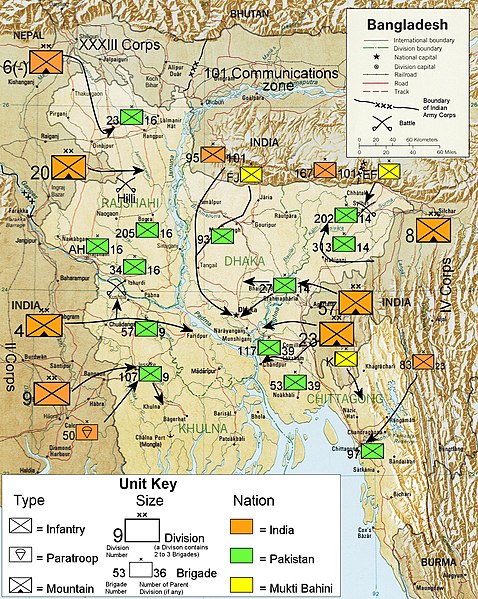
A Guerra Indo-Paquistanesa de 1971 começou há 51 anos, dando a independência ao Bangladesh
Postado por
Fernando Martins
às
00:51
0
bocas
Marcadores: Bangladesh, guerra, independência, Índia, Islão, Paquistão
domingo, agosto 07, 2022
Rabindranath Tagore morreu há oitenta e um anos
Disse-me baixinho:
— Meu amor, olha-me nos olhos.
Ralhei-lhe, duramente, e disse-lhe:
— Vai-te embora.
Mas ele não foi.
Chegou ao pé de mim e agarrou-me as mãos...
Eu disse-lhe:
— Deixa-me.
Mas ele não deixou.
Encostou a cara ao meu ouvido.
Afastei-me um pouco,
fiquei a olhá-lo e disse-lhe:
— Não tens vergonha? Nem se moveu.
Os seus lábios roçaram a minha face.
Estremeci e disse-lhe:
— Como te atreves?
Mas ele não se envergonhou.
Prendeu-me uma flor no cabelo.
Eu disse-lhe:
— É inútil.
Mas ele não fez caso.
Tirou-me a grinalda do pescoço
e abalou.
Continuo a chorar,
e pergunto ao meu coração:
Porque é que ele não volta?
in O Coração da Primavera - Rabindranath Tagore
Postado por
Fernando Martins
às
08:10
0
bocas
Marcadores: Bangladesh, bengali, Índia, Índia Britânica, literatura, música, poesia, polímata, Prémio Nobel, Rabindranath Tagore