Mostrar mensagens com a etiqueta XXI Emenda. Mostrar todas as mensagens

sexta-feira, dezembro 05, 2025

A Lei Seca norte-americana acabou há 92 anos...!

https://upload.wikimedia.org/wikipedia/commons/thumb/e/e4/Raceland_Louisiana_Beer_Drinkers_Russell_Lee.jpg/800px-Raceland_Louisiana_Beer_Drinkers_Russell_Lee.jpg

Pre-Prohibition saloons were mostly male establishments; post-Prohibition bars catered to both males and females
       
The Twenty-first Amendment (Amendment XXI) to the United States Constitution repealed the Eighteenth Amendment to the United States Constitution, which had mandated nationwide Prohibition on alcohol on January 17, 1920. The Twenty-first amendment was ratified on December 5, 1933. It is unique among the 27 Amendments of the U.S. Constitution for being the only one to repeal a previous Amendment, and for being the only one to have been ratified by the method of the state ratifying convention.
   
Text
Section 2. The transportation or importation into any State, Territory, or possession of the United States for delivery or use therein of intoxicating liquors, in violation of the laws thereof, is hereby prohibited.
Section 3. This article shall be inoperative unless it shall have been ratified as an amendment to the Constitution by conventions in the several States, as provided in the Constitution, within seven years from the date of the submission hereof to the States by the Congress.
  
Backgroud
The Eighteenth Amendment to the Constitution had ushered in a period of time known as Prohibition, during which the manufacture, distribution, and sale of alcoholic beverages was illegal. Passage of the Eighteenth Amendment in 1919 was the crowning achievement of the temperance movement, but it soon proved highly unpopular. Crime rates soared under Prohibition as gangsters, such as Chicago's Al Capone, became rich from a profitable, often violent, black market for alcohol. The federal government was incapable of stemming the tide: enforcement of the Volstead Act proved to be a nearly impossible task and corruption was rife among law enforcement agencies. In 1932, wealthy industrialist John D. Rockefeller, Jr. stated in a letter:
When Prohibition was introduced, I hoped that it would be widely supported by public opinion and the day would soon come when the evil effects of alcohol would be recognized. I have slowly and reluctantly come to believe that this has not been the result. Instead, drinking has generally increased; the speakeasy has replaced the saloon; a vast army of lawbreakers has appeared; many of our best citizens have openly ignored Prohibition; respect for the law has been greatly lessened; and crime has increased to a level never seen before.
As more and more Americans opposed the Eighteenth Amendment, a political movement grew for its repeal. However, repeal was complicated by grassroots politics. Although the U.S. Constitution provides two methods for ratifying constitutional amendments, only one method had been used up until that time; and that was for ratification by the state legislatures of three-fourths of the states. However, the wisdom of the day was that the lawmakers of many states were either beholden to or simply fearful of the temperance lobby. For that reason, when Congress formally proposed the repeal of Prohibition on February 20, 1933 (with the requisite two-thirds having voted in favor in each house; 63 to 21 in the United States Senate and 289 to 121 in the United States House of Representatives), they chose the other ratification method established by Article V, that being via state conventions. The Twenty-first Amendment is, thus far in American history, the only constitutional amendment ratified by state conventions rather than by the state legislatures.
    
Proposal and ratification
The Congress proposed the Twenty-first Amendment on February 20, 1933.
The proposed amendment was adopted on December 5, 1933. It is the only amendment to have been ratified by state ratifying conventions, specially selected for the purpose. All other amendments have been ratified by state legislatures. It is also the only amendment that was approved for the explicit purpose of repealing a previously-existing amendment to the Constitution. The Twenty-first Amendment ending national prohibition became officially effective on December 15, though people started drinking openly before that date.


sexta-feira, janeiro 17, 2025

A Lei Seca (norte-americana...) entrou em vigor há 105 anos

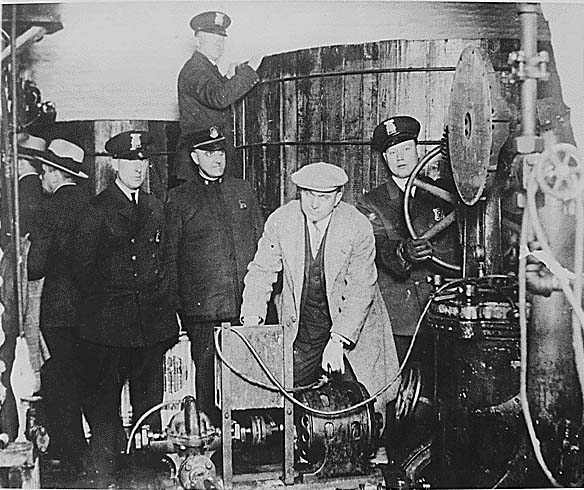
Detroit police inspecting equipment found in a clandestine underground brewery during the Prohibition era
   
Prohibition in the United States (sometimes referred to as the Noble Experiment) was a national ban on the sale, manufacture, and transportation of alcohol, in place from 1920 to 1933. The ban was mandated by the Eighteenth Amendment to the Constitution, and the Volstead Act set down the rules for enforcing the ban, as well as defining which "intoxicating liquors" were prohibited. Prohibition ended with the ratification of the Twenty-first Amendment, which repealed the Eighteenth Amendment, on December 5, 1933.

The Senate proposed the Eighteenth Amendment on December 18, 1917. Having been approved by 36 states, the 18th Amendment was ratified on January 16, 1919 and effected on January 17, 1920.
On November 18, 1918, before the ratification of the Eighteenth Amendment, the United States Congress passed the temporary Wartime Prohibition Act, which banned the sale of alcoholic beverages having an alcohol content of greater than 2.75%. (This act, which was intended to save grain for the war effort, was passed after the armistice was signed on November 11, 1918.) The Wartime Prohibition Act took effect June 30, 1919, and July 1, 1919 became widely known as the "Thirsty-First".
Congress passed the Volstead Act, the popular name for the National Prohibition Act, over President Woodrow Wilson's veto on October 28, 1919, and established the legal definition of intoxicating liquor, as well as penalties for producing it. Though the Volstead Act prohibited the sale of alcohol, the federal government did little to enforce it. By 1925, in New York City alone, there were anywhere from 30,000 to 100,000 speakeasy clubs.
While Prohibition was successful in reducing the amount of liquor consumed, it stimulated the proliferation of rampant underground, organized and widespread criminal activity. The bulk of America became disenchanted after the St. Valentine's Day massacre in 1929. Prohibition became increasingly unpopular during the Great Depression, especially in large cities.
On March 22, 1933, President Franklin Roosevelt signed into law an amendment to the Volstead Act known as the Cullen-Harrison Act, allowing the manufacture and sale of certain kinds of alcoholic beverages. On December 5, 1933, the ratification of the Twenty-first Amendment repealed the Eighteenth Amendment. However, United States federal law still prohibits the manufacture of distilled spirits without meeting numerous licensing requirements that make it impractical to produce spirits for personal beverage use.
 
(...)

Organized crime received a major boost from Prohibition. Mafia groups limited their activities to prostitution, gambling, and theft until 1920, when organized bootlegging manifested in response to the effect of Prohibition. A profitable, often violent, black market for alcohol flourished. Powerful gangs corrupted law enforcement agencies, leading to racketeering. In essence prohibition provided a financial basis for organized crime to flourish. Rather than reducing crime it seemed prohibition had transformed the cities into battlegrounds between opposing bootlegging gangs. In a study of over 30 major U.S cities during the prohibition years of 1920 and 1921, the number of crimes increased by 24%. Additionally, theft and burglaries increased by 9%, homicide by 12.7%, assaults and battery rose by 13%, drug addiction by 44.6% and police department costs rose by 11.4%. It has been speculated that this was largely the result of “black-market violence” as well as law enforcing resources having been diverted elsewhere. Despite the beliefs of the prohibitionist movement that by outlawing alcohol crime would surely be reduced, the reality was that the Volstead Act led to worse social conditions than were experienced prior to prohibition as demonstrated by more lethal forms of alcohol, increased crime rates, and the establishment of a black market dominated by criminal organizations.

quinta-feira, dezembro 05, 2024

A Lei Seca norte-americana acabou há 91 anos...!

Pre-Prohibition saloons were mostly male establishments; post-Prohibition bars catered to both males and females
    
The Twenty-first Amendment (Amendment XXI) to the United States Constitution repealed the Eighteenth Amendment to the United States Constitution, which had mandated nationwide Prohibition on alcohol on January 17, 1920. The Twenty-first amendment was ratified on December 5, 1933. It is unique among the 27 Amendments of the U.S. Constitution for being the only one to repeal a previous Amendment, and for being the only one to have been ratified by the method of the state ratifying convention.
   
Text
Section 2. The transportation or importation into any State, Territory, or possession of the United States for delivery or use therein of intoxicating liquors, in violation of the laws thereof, is hereby prohibited.
Section 3. This article shall be inoperative unless it shall have been ratified as an amendment to the Constitution by conventions in the several States, as provided in the Constitution, within seven years from the date of the submission hereof to the States by the Congress.
  
Backgroud
The Eighteenth Amendment to the Constitution had ushered in a period of time known as Prohibition, during which the manufacture, distribution, and sale of alcoholic beverages was illegal. Passage of the Eighteenth Amendment in 1919 was the crowning achievement of the temperance movement, but it soon proved highly unpopular. Crime rates soared under Prohibition as gangsters, such as Chicago's Al Capone, became rich from a profitable, often violent, black market for alcohol. The federal government was incapable of stemming the tide: enforcement of the Volstead Act proved to be a nearly impossible task and corruption was rife among law enforcement agencies. In 1932, wealthy industrialist John D. Rockefeller, Jr. stated in a letter:
When Prohibition was introduced, I hoped that it would be widely supported by public opinion and the day would soon come when the evil effects of alcohol would be recognized. I have slowly and reluctantly come to believe that this has not been the result. Instead, drinking has generally increased; the speakeasy has replaced the saloon; a vast army of lawbreakers has appeared; many of our best citizens have openly ignored Prohibition; respect for the law has been greatly lessened; and crime has increased to a level never seen before.
As more and more Americans opposed the Eighteenth Amendment, a political movement grew for its repeal. However, repeal was complicated by grassroots politics. Although the U.S. Constitution provides two methods for ratifying constitutional amendments, only one method had been used up until that time; and that was for ratification by the state legislatures of three-fourths of the states. However, the wisdom of the day was that the lawmakers of many states were either beholden to or simply fearful of the temperance lobby. For that reason, when Congress formally proposed the repeal of Prohibition on February 20, 1933 (with the requisite two-thirds having voted in favor in each house; 63 to 21 in the United States Senate and 289 to 121 in the United States House of Representatives), they chose the other ratification method established by Article V, that being via state conventions. The Twenty-first Amendment is, thus far in American history, the only constitutional amendment ratified by state conventions rather than by the state legislatures.
    
Proposal and ratification
The Congress proposed the Twenty-first Amendment on February 20, 1933.
The proposed amendment was adopted on December 5, 1933. It is the only amendment to have been ratified by state ratifying conventions, specially selected for the purpose. All other amendments have been ratified by state legislatures. It is also the only amendment that was approved for the explicit purpose of repealing a previously-existing amendment to the Constitution. The Twenty-first Amendment ending national prohibition became officially effective on December 15, though people started drinking openly before that date.
    

quarta-feira, janeiro 17, 2024

A Lei Seca norte-americana entrou em vigor há 104 anos

Detroit police inspecting equipment found in a clandestine underground brewery during the Prohibition era
   
Prohibition in the United States (sometimes referred to as the Noble Experiment) was a national ban on the sale, manufacture, and transportation of alcohol, in place from 1920 to 1933. The ban was mandated by the Eighteenth Amendment to the Constitution, and the Volstead Act set down the rules for enforcing the ban, as well as defining which "intoxicating liquors" were prohibited. Prohibition ended with the ratification of the Twenty-first Amendment, which repealed the Eighteenth Amendment, on December 5, 1933.

The Senate proposed the Eighteenth Amendment on December 18, 1917. Having been approved by 36 states, the 18th Amendment was ratified on January 16, 1919 and effected on January 17, 1920.
On November 18, 1918, before the ratification of the Eighteenth Amendment, the United States Congress passed the temporary Wartime Prohibition Act, which banned the sale of alcoholic beverages having an alcohol content of greater than 2.75%. (This act, which was intended to save grain for the war effort, was passed after the armistice was signed on November 11, 1918.) The Wartime Prohibition Act took effect June 30, 1919, and July 1, 1919 became widely known as the "Thirsty-First".
Congress passed the Volstead Act, the popular name for the National Prohibition Act, over President Woodrow Wilson's veto on October 28, 1919, and established the legal definition of intoxicating liquor, as well as penalties for producing it. Though the Volstead Act prohibited the sale of alcohol, the federal government did little to enforce it. By 1925, in New York City alone, there were anywhere from 30,000 to 100,000 speakeasy clubs.
While Prohibition was successful in reducing the amount of liquor consumed, it stimulated the proliferation of rampant underground, organized and widespread criminal activity. The bulk of America became disenchanted after the St. Valentine's Day massacre in 1929. Prohibition became increasingly unpopular during the Great Depression, especially in large cities.
On March 22, 1933, President Franklin Roosevelt signed into law an amendment to the Volstead Act known as the Cullen-Harrison Act, allowing the manufacture and sale of certain kinds of alcoholic beverages. On December 5, 1933, the ratification of the Twenty-first Amendment repealed the Eighteenth Amendment. However, United States federal law still prohibits the manufacture of distilled spirits without meeting numerous licensing requirements that make it impractical to produce spirits for personal beverage use.
 
(...)

Organized crime received a major boost from Prohibition. Mafia groups limited their activities to prostitution, gambling, and theft until 1920, when organized bootlegging manifested in response to the effect of Prohibition. A profitable, often violent, black market for alcohol flourished. Powerful gangs corrupted law enforcement agencies, leading to racketeering. In essence prohibition provided a financial basis for organized crime to flourish. Rather than reducing crime it seemed prohibition had transformed the cities into battlegrounds between opposing bootlegging gangs. In a study of over 30 major U.S cities during the prohibition years of 1920 and 1921, the number of crimes increased by 24%. Additionally, theft and burglaries increased by 9%, homicide by 12.7%, assaults and battery rose by 13%, drug addiction by 44.6% and police department costs rose by 11.4%. It has been speculated that this was largely the result of “black-market violence” as well as law enforcing resources having been diverted elsewhere. Despite the beliefs of the prohibitionist movement that by outlawing alcohol crime would surely be reduced, the reality was that the Volstead Act led to worse social conditions than were experienced prior to prohibition as demonstrated by more lethal forms of alcohol, increased crime rates, and the establishment of a black market dominated by criminal organizations.

terça-feira, dezembro 05, 2023

A Lei Seca norte-americana acabou há noventa anos...!


Pre-Prohibition saloons were mostly male establishments; post-Prohibition bars catered to both males and females
    
The Twenty-first Amendment (Amendment XXI) to the United States Constitution repealed the Eighteenth Amendment to the United States Constitution, which had mandated nationwide Prohibition on alcohol on January 17, 1920. The Twenty-first amendment was ratified on December 5, 1933. It is unique among the 27 Amendments of the U.S. Constitution for being the only one to repeal a previous Amendment, and for being the only one to have been ratified by the method of the state ratifying convention.
   
Text
Section 2. The transportation or importation into any State, Territory, or possession of the United States for delivery or use therein of intoxicating liquors, in violation of the laws thereof, is hereby prohibited.
Section 3. This article shall be inoperative unless it shall have been ratified as an amendment to the Constitution by conventions in the several States, as provided in the Constitution, within seven years from the date of the submission hereof to the States by the Congress.
  
Backgroud
The Eighteenth Amendment to the Constitution had ushered in a period of time known as Prohibition, during which the manufacture, distribution, and sale of alcoholic beverages was illegal. Passage of the Eighteenth Amendment in 1919 was the crowning achievement of the temperance movement, but it soon proved highly unpopular. Crime rates soared under Prohibition as gangsters, such as Chicago's Al Capone, became rich from a profitable, often violent, black market for alcohol. The federal government was incapable of stemming the tide: enforcement of the Volstead Act proved to be a nearly impossible task and corruption was rife among law enforcement agencies. In 1932, wealthy industrialist John D. Rockefeller, Jr. stated in a letter:
When Prohibition was introduced, I hoped that it would be widely supported by public opinion and the day would soon come when the evil effects of alcohol would be recognized. I have slowly and reluctantly come to believe that this has not been the result. Instead, drinking has generally increased; the speakeasy has replaced the saloon; a vast army of lawbreakers has appeared; many of our best citizens have openly ignored Prohibition; respect for the law has been greatly lessened; and crime has increased to a level never seen before.
As more and more Americans opposed the Eighteenth Amendment, a political movement grew for its repeal. However, repeal was complicated by grassroots politics. Although the U.S. Constitution provides two methods for ratifying constitutional amendments, only one method had been used up until that time; and that was for ratification by the state legislatures of three-fourths of the states. However, the wisdom of the day was that the lawmakers of many states were either beholden to or simply fearful of the temperance lobby. For that reason, when Congress formally proposed the repeal of Prohibition on February 20, 1933 (with the requisite two-thirds having voted in favor in each house; 63 to 21 in the United States Senate and 289 to 121 in the United States House of Representatives), they chose the other ratification method established by Article V, that being via state conventions. The Twenty-first Amendment is, thus far in American history, the only constitutional amendment ratified by state conventions rather than by the state legislatures.
    
Proposal and ratification
The Congress proposed the Twenty-first Amendment on February 20, 1933.
The proposed amendment was adopted on December 5, 1933. It is the only amendment to have been ratified by state ratifying conventions, specially selected for the purpose. All other amendments have been ratified by state legislatures. It is also the only amendment that was approved for the explicit purpose of repealing a previously-existing amendment to the Constitution. The Twenty-first Amendment ending national prohibition became officially effective on December 15, though people started drinking openly before that date.
    

terça-feira, janeiro 17, 2023

A Lei Seca norte-americana começou, oficialmente, há 103 anos

Detroit police inspecting equipment found in a clandestine underground brewery during the Prohibition era

Prohibition in the United States (sometimes referred to as the Noble Experiment) was a national ban on the sale, manufacture, and transportation of alcohol, in place from 1920 to 1933. The ban was mandated by the Eighteenth Amendment to the Constitution, and the Volstead Act set down the rules for enforcing the ban, as well as defining which "intoxicating liquors" were prohibited. Prohibition ended with the ratification of the Twenty-first Amendment, which repealed the Eighteenth Amendment, on December 5, 1933.

The Senate proposed the Eighteenth Amendment on December 18, 1917. Having been approved by 36 states, the 18th Amendment was ratified on January 16, 1919 and effected on January 17, 1920.
On November 18, 1918, before the ratification of the Eighteenth Amendment, the United States Congress passed the temporary Wartime Prohibition Act, which banned the sale of alcoholic beverages having an alcohol content of greater than 2.75%. (This act, which was intended to save grain for the war effort, was passed after the armistice was signed on November 11, 1918.) The Wartime Prohibition Act took effect June 30, 1919, and July 1, 1919 became widely known as the "Thirsty-First".
Congress passed the Volstead Act, the popular name for the National Prohibition Act, over President Woodrow Wilson's veto on October 28, 1919, and established the legal definition of intoxicating liquor, as well as penalties for producing it. Though the Volstead Act prohibited the sale of alcohol, the federal government did little to enforce it. By 1925, in New York City alone, there were anywhere from 30,000 to 100,000 speakeasy clubs.
While Prohibition was successful in reducing the amount of liquor consumed, it stimulated the proliferation of rampant underground, organized and widespread criminal activity. The bulk of America became disenchanted after the St. Valentine's Day massacre in 1929. Prohibition became increasingly unpopular during the Great Depression, especially in large cities.
On March 22, 1933, President Franklin Roosevelt signed into law an amendment to the Volstead Act known as the Cullen-Harrison Act, allowing the manufacture and sale of certain kinds of alcoholic beverages. On December 5, 1933, the ratification of the Twenty-first Amendment repealed the Eighteenth Amendment. However, United States federal law still prohibits the manufacture of distilled spirits without meeting numerous licensing requirements that make it impractical to produce spirits for personal beverage use.
 
(...)

Organized crime received a major boost from Prohibition. Mafia groups limited their activities to prostitution, gambling, and theft until 1920, when organized bootlegging manifested in response to the effect of Prohibition. A profitable, often violent, black market for alcohol flourished. Powerful gangs corrupted law enforcement agencies, leading to racketeering. In essence prohibition provided a financial basis for organized crime to flourish. Rather than reducing crime it seemed prohibition had transformed the cities into battlegrounds between opposing bootlegging gangs. In a study of over 30 major U.S cities during the prohibition years of 1920 and 1921, the number of crimes increased by 24%. Additionally, theft and burglaries increased by 9%, homicide by 12.7%, assaults and battery rose by 13%, drug addiction by 44.6% and police department costs rose by 11.4%. It has been speculated that this was largely the result of “black-market violence” as well as law enforcing resources having been diverted elsewhere. Despite the beliefs of the prohibitionist movement that by outlawing alcohol crime would surely be reduced, the reality was that the Volstead Act led to worse social conditions than were experienced prior to prohibition as demonstrated by more lethal forms of alcohol, increased crime rates, and the establishment of a black market dominated by criminal organizations.

segunda-feira, dezembro 05, 2022

A Lei Seca norte-americana acabou há 89 anos

Pre-Prohibition saloons were mostly male establishments; post-Prohibition bars catered to both males and females
  
The Twenty-first Amendment (Amendment XXI) to the United States Constitution repealed the Eighteenth Amendment to the United States Constitution, which had mandated nationwide Prohibition on alcohol on January 17, 1920. The Twenty-first amendment was ratified on December 5, 1933. It is unique among the 27 Amendments of the U.S. Constitution for being the only one to repeal a previous Amendment, and for being the only one to have been ratified by the method of the state ratifying convention.
   
Text
Section 2. The transportation or importation into any State, Territory, or possession of the United States for delivery or use therein of intoxicating liquors, in violation of the laws thereof, is hereby prohibited.
Section 3. This article shall be inoperative unless it shall have been ratified as an amendment to the Constitution by conventions in the several States, as provided in the Constitution, within seven years from the date of the submission hereof to the States by the Congress.
  
Backgroud
The Eighteenth Amendment to the Constitution had ushered in a period of time known as Prohibition, during which the manufacture, distribution, and sale of alcoholic beverages was illegal. Passage of the Eighteenth Amendment in 1919 was the crowning achievement of the temperance movement, but it soon proved highly unpopular. Crime rates soared under Prohibition as gangsters, such as Chicago's Al Capone, became rich from a profitable, often violent, black market for alcohol. The federal government was incapable of stemming the tide: enforcement of the Volstead Act proved to be a nearly impossible task and corruption was rife among law enforcement agencies. In 1932, wealthy industrialist John D. Rockefeller, Jr. stated in a letter:
When Prohibition was introduced, I hoped that it would be widely supported by public opinion and the day would soon come when the evil effects of alcohol would be recognized. I have slowly and reluctantly come to believe that this has not been the result. Instead, drinking has generally increased; the speakeasy has replaced the saloon; a vast army of lawbreakers has appeared; many of our best citizens have openly ignored Prohibition; respect for the law has been greatly lessened; and crime has increased to a level never seen before.
As more and more Americans opposed the Eighteenth Amendment, a political movement grew for its repeal. However, repeal was complicated by grassroots politics. Although the U.S. Constitution provides two methods for ratifying constitutional amendments, only one method had been used up until that time; and that was for ratification by the state legislatures of three-fourths of the states. However, the wisdom of the day was that the lawmakers of many states were either beholden to or simply fearful of the temperance lobby. For that reason, when Congress formally proposed the repeal of Prohibition on February 20, 1933 (with the requisite two-thirds having voted in favor in each house; 63 to 21 in the United States Senate and 289 to 121 in the United States House of Representatives), they chose the other ratification method established by Article V, that being via state conventions. The Twenty-first Amendment is, thus far in American history, the only constitutional amendment ratified by state conventions rather than by the state legislatures.
    
Proposal and ratification
The Congress proposed the Twenty-first Amendment on February 20, 1933.
The proposed amendment was adopted on December 5, 1933. It is the only amendment to have been ratified by state ratifying conventions, specially selected for the purpose. All other amendments have been ratified by state legislatures. It is also the only amendment that was approved for the explicit purpose of repealing a previously-existing amendment to the Constitution. The Twenty-first Amendment ending national prohibition became officially effective on December 15, though people started drinking openly before that date.
    

segunda-feira, janeiro 17, 2022

A Lei Seca americana começou, oficialmente, há 102 anos

Detroit police inspecting equipment found in a clandestine underground brewery during the Prohibition era

Prohibition in the United States (sometimes referred to as the Noble Experiment) was a national ban on the sale, manufacture, and transportation of alcohol, in place from 1920 to 1933. The ban was mandated by the Eighteenth Amendment to the Constitution, and the Volstead Act set down the rules for enforcing the ban, as well as defining which "intoxicating liquors" were prohibited. Prohibition ended with the ratification of the Twenty-first Amendment, which repealed the Eighteenth Amendment, on December 5, 1933.

The Senate proposed the Eighteenth Amendment on December 18, 1917. Having been approved by 36 states, the 18th Amendment was ratified on January 16, 1919 and effected on January 17, 1920.
On November 18, 1918, before the ratification of the Eighteenth Amendment, the United States Congress passed the temporary Wartime Prohibition Act, which banned the sale of alcoholic beverages having an alcohol content of greater than 2.75%. (This act, which was intended to save grain for the war effort, was passed after the armistice was signed on November 11, 1918.) The Wartime Prohibition Act took effect June 30, 1919, and July 1, 1919 became widely known as the "Thirsty-First".
Congress passed the Volstead Act, the popular name for the National Prohibition Act, over President Woodrow Wilson's veto on October 28, 1919, and established the legal definition of intoxicating liquor, as well as penalties for producing it. Though the Volstead Act prohibited the sale of alcohol, the federal government did little to enforce it. By 1925, in New York City alone, there were anywhere from 30,000 to 100,000 speakeasy clubs.
While Prohibition was successful in reducing the amount of liquor consumed, it stimulated the proliferation of rampant underground, organized and widespread criminal activity. The bulk of America became disenchanted after the St. Valentine's Day massacre in 1929. Prohibition became increasingly unpopular during the Great Depression, especially in large cities.
On March 22, 1933, President Franklin Roosevelt signed into law an amendment to the Volstead Act known as the Cullen-Harrison Act, allowing the manufacture and sale of certain kinds of alcoholic beverages. On December 5, 1933, the ratification of the Twenty-first Amendment repealed the Eighteenth Amendment. However, United States federal law still prohibits the manufacture of distilled spirits without meeting numerous licensing requirements that make it impractical to produce spirits for personal beverage use.
 
(...)

Organized crime received a major boost from Prohibition. Mafia groups limited their activities to prostitution, gambling, and theft until 1920, when organized bootlegging manifested in response to the effect of Prohibition. A profitable, often violent, black market for alcohol flourished. Powerful gangs corrupted law enforcement agencies, leading to racketeering. In essence prohibition provided a financial basis for organized crime to flourish. Rather than reducing crime it seemed prohibition had transformed the cities into battlegrounds between opposing bootlegging gangs. In a study of over 30 major U.S cities during the prohibition years of 1920 and 1921, the number of crimes increased by 24%. Additionally, theft and burglaries increased by 9%, homicide by 12.7%, assaults and battery rose by 13%, drug addiction by 44.6% and police department costs rose by 11.4%. It has been speculated that this was largely the result of “black-market violence” as well as law enforcing resources having been diverted elsewhere. Despite the beliefs of the prohibitionist movement that by outlawing alcohol crime would surely be reduced, the reality was that the Volstead Act led to worse social conditions than were experienced prior to prohibition as demonstrated by more lethal forms of alcohol, increased crime rates, and the establishment of a black market dominated by criminal organizations.

domingo, dezembro 05, 2021

A Lei Seca americana acabou há 88 anos

Pre-Prohibition saloons were mostly male establishments; post-Prohibition bars catered to both males and females
  
The Twenty-first Amendment (Amendment XXI) to the United States Constitution repealed the Eighteenth Amendment to the United States Constitution, which had mandated nationwide Prohibition on alcohol on January 17, 1920. The Twenty-first amendment was ratified on December 5, 1933. It is unique among the 27 Amendments of the U.S. Constitution for being the only one to repeal a previous Amendment, and for being the only one to have been ratified by the method of the state ratifying convention.
   
Text
Section 2. The transportation or importation into any State, Territory, or possession of the United States for delivery or use therein of intoxicating liquors, in violation of the laws thereof, is hereby prohibited.
Section 3. This article shall be inoperative unless it shall have been ratified as an amendment to the Constitution by conventions in the several States, as provided in the Constitution, within seven years from the date of the submission hereof to the States by the Congress.
  
Backgroud
The Eighteenth Amendment to the Constitution had ushered in a period of time known as Prohibition, during which the manufacture, distribution, and sale of alcoholic beverages was illegal. Passage of the Eighteenth Amendment in 1919 was the crowning achievement of the temperance movement, but it soon proved highly unpopular. Crime rates soared under Prohibition as gangsters, such as Chicago's Al Capone, became rich from a profitable, often violent, black market for alcohol. The federal government was incapable of stemming the tide: enforcement of the Volstead Act proved to be a nearly impossible task and corruption was rife among law enforcement agencies. In 1932, wealthy industrialist John D. Rockefeller, Jr. stated in a letter:
When Prohibition was introduced, I hoped that it would be widely supported by public opinion and the day would soon come when the evil effects of alcohol would be recognized. I have slowly and reluctantly come to believe that this has not been the result. Instead, drinking has generally increased; the speakeasy has replaced the saloon; a vast army of lawbreakers has appeared; many of our best citizens have openly ignored Prohibition; respect for the law has been greatly lessened; and crime has increased to a level never seen before.
As more and more Americans opposed the Eighteenth Amendment, a political movement grew for its repeal. However, repeal was complicated by grassroots politics. Although the U.S. Constitution provides two methods for ratifying constitutional amendments, only one method had been used up until that time; and that was for ratification by the state legislatures of three-fourths of the states. However, the wisdom of the day was that the lawmakers of many states were either beholden to or simply fearful of the temperance lobby. For that reason, when Congress formally proposed the repeal of Prohibition on February 20, 1933 (with the requisite two-thirds having voted in favor in each house; 63 to 21 in the United States Senate and 289 to 121 in the United States House of Representatives), they chose the other ratification method established by Article V, that being via state conventions. The Twenty-first Amendment is, thus far in American history, the only constitutional amendment ratified by state conventions rather than by the state legislatures.
    
Proposal and ratification
The Congress proposed the Twenty-first Amendment on February 20, 1933.
The proposed amendment was adopted on December 5, 1933. It is the only amendment to have been ratified by state ratifying conventions, specially selected for the purpose. All other amendments have been ratified by state legislatures. It is also the only amendment that was approved for the explicit purpose of repealing a previously-existing amendment to the Constitution. The Twenty-first Amendment ending national prohibition became officially effective on December 15, though people started drinking openly before that date.
    

quarta-feira, dezembro 05, 2018

A Lei Seca americana acabou há 85 anos

Pre-Prohibition saloons were mostly male establishments; post-Prohibition bars catered to both males and females
  
The Twenty-first Amendment (Amendment XXI) to the United States Constitution repealed the Eighteenth Amendment to the United States Constitution, which had mandated nationwide Prohibition on alcohol on January 17, 1920. The Twenty-first amendment was ratified on December 5, 1933. It is unique among the 27 Amendments of the U.S. Constitution for being the only one to repeal a previous Amendment, and for being the only one to have been ratified by the method of the state ratifying convention.
  
Text
Section 2. The transportation or importation into any State, Territory, or possession of the United States for delivery or use therein of intoxicating liquors, in violation of the laws thereof, is hereby prohibited.
Section 3. This article shall be inoperative unless it shall have been ratified as an amendment to the Constitution by conventions in the several States, as provided in the Constitution, within seven years from the date of the submission hereof to the States by the Congress.
Backgroud
The Eighteenth Amendment to the Constitution had ushered in a period of time known as Prohibition, during which the manufacture, distribution, and sale of alcoholic beverages was illegal. Passage of the Eighteenth Amendment in 1919 was the crowning achievement of the temperance movement, but it soon proved highly unpopular. Crime rates soared under Prohibition as gangsters, such as Chicago's Al Capone, became rich from a profitable, often violent, black market for alcohol. The federal government was incapable of stemming the tide: enforcement of the Volstead Act proved to be a nearly impossible task and corruption was rife among law enforcement agencies. In 1932, wealthy industrialist John D. Rockefeller, Jr. stated in a letter:
When Prohibition was introduced, I hoped that it would be widely supported by public opinion and the day would soon come when the evil effects of alcohol would be recognized. I have slowly and reluctantly come to believe that this has not been the result. Instead, drinking has generally increased; the speakeasy has replaced the saloon; a vast army of lawbreakers has appeared; many of our best citizens have openly ignored Prohibition; respect for the law has been greatly lessened; and crime has increased to a level never seen before.
As more and more Americans opposed the Eighteenth Amendment, a political movement grew for its repeal. However, repeal was complicated by grassroots politics. Although the U.S. Constitution provides two methods for ratifying constitutional amendments, only one method had been used up until that time; and that was for ratification by the state legislatures of three-fourths of the states. However, the wisdom of the day was that the lawmakers of many states were either beholden to or simply fearful of the temperance lobby. For that reason, when Congress formally proposed the repeal of Prohibition on February 20, 1933 (with the requisite two-thirds having voted in favor in each house; 63 to 21 in the United States Senate and 289 to 121 in the United States House of Representatives), they chose the other ratification method established by Article V, that being via state conventions. The Twenty-first Amendment is, thus far in American history, the only constitutional amendment ratified by state conventions rather than by the state legislatures.
Proposal and ratification
The Congress proposed the Twenty-first Amendment on February 20, 1933.
The proposed amendment was adopted on December 5, 1933. It is the only amendment to have been ratified by state ratifying conventions, specially selected for the purpose. All other amendments have been ratified by state legislatures. It is also the only amendment that was approved for the explicit purpose of repealing a previously-existing amendment to the Constitution. The Twenty-first Amendment ending national prohibition became officially effective on December 15, though people started drinking openly before that date.

quinta-feira, dezembro 05, 2013

A Lei Seca acabou nos Estados Unidos há 80 anos

Pre-Prohibition saloons were mostly male establishments; post-Prohibition bars catered to both males and females

The Twenty-first Amendment (Amendment XXI) to the United States Constitution repealed the Eighteenth Amendment to the United States Constitution, which had mandated nationwide Prohibition on alcohol on January 17, 1920. The Twenty-first amendment was ratified on December 5, 1933. It is unique among the 27 Amendments of the U.S. Constitution for being the only one to repeal a previous Amendment, and for being the only one to have been ratified by the method of the state ratifying convention.

Text
Section 2. The transportation or importation into any State, Territory, or possession of the United States for delivery or use therein of intoxicating liquors, in violation of the laws thereof, is hereby prohibited.
Section 3. This article shall be inoperative unless it shall have been ratified as an amendment to the Constitution by conventions in the several States, as provided in the Constitution, within seven years from the date of the submission hereof to the States by the Congress.
Backgroud
The Eighteenth Amendment to the Constitution had ushered in a period of time known as Prohibition, during which the manufacture, distribution, and sale of alcoholic beverages was illegal. Passage of the Eighteenth Amendment in 1919 was the crowning achievement of the temperance movement, but it soon proved highly unpopular. Crime rates soared under Prohibition as gangsters, such as Chicago's Al Capone, became rich from a profitable, often violent, black market for alcohol. The federal government was incapable of stemming the tide: enforcement of the Volstead Act proved to be a nearly impossible task and corruption was rife among law enforcement agencies. In 1932, wealthy industrialist John D. Rockefeller, Jr. stated in a letter:
When Prohibition was introduced, I hoped that it would be widely supported by public opinion and the day would soon come when the evil effects of alcohol would be recognized. I have slowly and reluctantly come to believe that this has not been the result. Instead, drinking has generally increased; the speakeasy has replaced the saloon; a vast army of lawbreakers has appeared; many of our best citizens have openly ignored Prohibition; respect for the law has been greatly lessened; and crime has increased to a level never seen before.
As more and more Americans opposed the Eighteenth Amendment, a political movement grew for its repeal. However, repeal was complicated by grassroots politics. Although the U.S. Constitution provides two methods for ratifying constitutional amendments, only one method had been used up until that time; and that was for ratification by the state legislatures of three-fourths of the states. However, the wisdom of the day was that the lawmakers of many states were either beholden to or simply fearful of the temperance lobby. For that reason, when Congress formally proposed the repeal of Prohibition on February 20, 1933 (with the requisite two-thirds having voted in favor in each house; 63 to 21 in the United States Senate and 289 to 121 in the United States House of Representatives), they chose the other ratification method established by Article V, that being via state conventions. The Twenty-first Amendment is, thus far in American history, the only constitutional amendment ratified by state conventions rather than by the state legislatures.

Proposal and ratification
The Congress proposed the Twenty-first Amendment on February 20, 1933.
The proposed amendment was adopted on December 5, 1933. It is the only amendment to have been ratified by state ratifying conventions, specially selected for the purpose. All other amendments have been ratified by state legislatures. It is also the only amendment that was approved for the explicit purpose of repealing a previously-existing amendment to the Constitution. The Twenty-first Amendment ending national prohibition became officially effective on December 15, though people started drinking openly before that date.