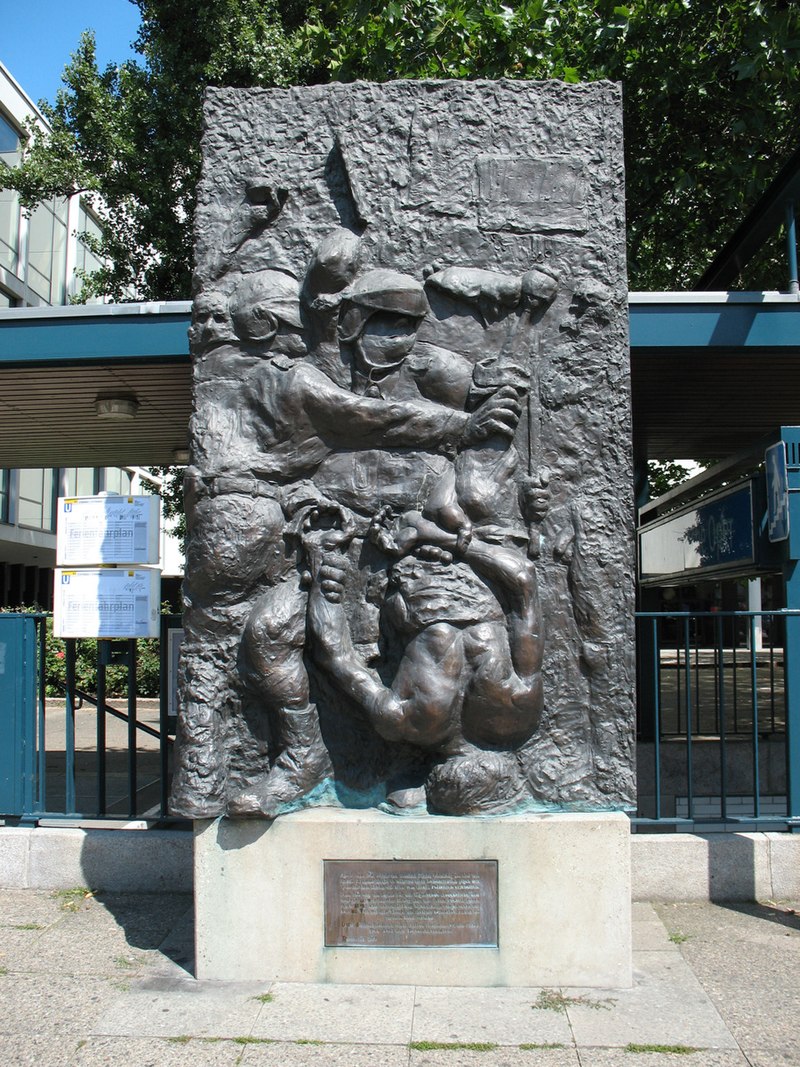
Relief Der Tod des Demonstranten (The Death of the Demonstrator) by Alfred Hrdlicka
Benno Ohnesorg (Hanôver, 15 de outubro de 1940 - Berlim, 2 de junho de 1967) foi um estudante alemão de Estudos Românicos e Germânicos, morto em frente à Ópera Alemã de Berlim, pelo polícia Karl-Heinz Hurras, com um tiro à queima-roupa, durante uma manifestação contra a visita do Xá Reza Pahlavi à RFA. Benno Ohnesorg era casado e a sua mulher estava grávida quando ele foi alvejado.
A sua morte, que provocou um grande impacto no movimento estudantil
alemão, teve grande influência sobre a radicalização política europeia
do fim dos anos 60. Pode mesmo ser considerada como um dos motores das revoltas estudantis de 1968 e contribuiu, mais tarde, para a emergência da Fração do Exército Vermelho (Baader-Meinhof).
Uma organização de extrema esquerda denominada Bewegung 2. Juni (Movimento 2 de junho) foi assim denominada em memória de Benno Ohnesorg.
Existe um memorial em sua honra, ao pé da Ópera Alemã de Berlim, e uma ponte em Hanover com o seu nome.
Benno Ohnesorg era também amigo do escritor Uwe Timm que escreveu o livro "der Freund und der Fremde" sobre a amizade dos dois e o seu trágico fim.
Mais de quarenta anos depois, foi revelado que Karl-Heinz Hurras era um agente da polícia secreta da Alemanha Oriental, a Stasi. Todavia o motivo da ação de Kurras não foi totalmente esclarecido. Os arquivos da Stasi não contêm evidência de que Hurras tivesse agido sob ordens da Alemanha Oriental quando atirou em Benno.
in Wikipédia

A ponte Benno Ohnesorg em Hannover
Benno Ohnesorg (Hanover, October 15, 1940 – West Berlin, June 2, 1967) was a German university student killed by a policeman during a demonstration in West Berlin.
Death
On June 2, 1967, Ohnesorg participated in a student protest held near the Deutsche Oper, in opposition to the state visit of the Shah of Iran, Mohammad Reza Pahlavi, who was attending a performance of Mozart's The Magic Flute at the Deutsche Oper that night. It was the first political demonstration in which Ohnesorg had ever taken part.
The protest turned violent after pro-Shah demonstrators, including agents of the Shah's intelligence service, began battling with students, and the police overreacted, employing brutal tactics in their attempts to control the crowd. In the ensuing tumult, demonstrators dispersed into the side streets. In the courtyard of Krumme Strasse 66, Ohnesorg was then shot by plain-clothes police officer Karl-Heinz Kurras. Ohnesorg died before he could be treated at a hospital. Kurras stood trial the same year and was acquitted, on 27 November 1967. Ohnesorg was a student of Romance and German studies. He was married and his wife was pregnant with their first child.
A week after Ohnesorg's death, a funeral caravan accompanied his
coffin as it was transported from West Berlin to his hometown of Hanover, in West Germany, where he was buried – a trip that led through checkpoints in East Germany on the way to the West.
Re-investigation
More than forty years later, in 2009, it was revealed that at the time of the events Kurras had been an informal collaborator of the East German secret police Stasi, and a long-time member of the Socialist Unity Party of Germany, the ruling East German Communist party; however, the motive behind Kurras' act remains unclear. The new information was based on documents discovered in the Stasi archives.
Initial reports indicated that the archives contained no evidence that
Kurras was acting under Stasi orders when he shot Ohnesorg.
On the basis of the 2009 revelations about Kurras, the German prosecutor's office
initiated a new investigation, in order to clarify definitively whether
there was any evidence that the killing of Ohnesorg could have been
ordered by authorities in East Berlin; in November 2011 that
investigation was officially closed, with the determination that there
was not enough evidence to justify reopening the case.
The prosecutor's office noted that, due to the passage of time, many
participants in the trial were either no longer alive or otherwise
unable to provide reliable testimony; also, documents relevant to the
case were evidently among those destroyed by the East German foreign intelligence service in the interval between the fall of the Berlin Wall, in 1989, and German reunification, in 1990.
Following up in January 2012, Der Spiegel
magazine reported that research carried out by federal prosecutors, as
well as by the magazine, found that the shooting was not in self-defense
as always claimed by Kurras and that it was certainly premeditated.
Newly examined film and photographic evidence also implicated fellow
officers and superiors, demonstrating that the police covered up the
truth in subsequent investigations and trials. Additionally, medical
staff who carried out the autopsy on Ohnesorg were ordered to falsify
their report. However, the Spiegel report indicated that the new information was still unlikely to be sufficient for the case to be reopened.
Legacy
Ohnesorg'e death served as a rallying point for the left, and spurred the growth of the left-wing German student movement; later, the Movement 2 June group (founded around 1971) was named for the day of his death. After student activist Rudi Dutschke called for direct action in response for the killing, Jürgen Habermas
famously invoked the term "left fascism" against elements within the
student movement. The student movement of the late 1960s that swelled
and partly radicalised itself after Ohnesorg's death influenced a large
number of German politicians who were in their teens and twenties at the
time.
A monument next to the Deutsche Oper Berlin, which was designed by Austrian sculptor Alfred Hrdlicka,
serves as a memorial for the killing. In December 2008, municipal
authorities inaugurated an official memorial panel on the sidewalk in
front of the house where Ohnesorg was shot. The panel is in German and
English.
In film
The introduction of the 2008 film Der Baader Meinhof Komplex shows Ohnesorg's death (he is played by Martin Glade).
In music
The Norwegian folk band Ohnesorg is named after Benno Ohnesorg.
in Wikipédia




Sem comentários:
Enviar um comentário