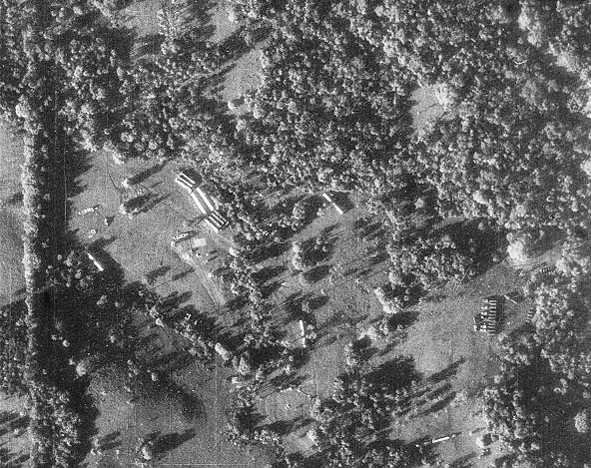
U-2 reconnaissance photograph of Soviet nuclear missiles in Cuba. Missile transports and tents for fueling and maintenance are visible. Photo taken by the CIA
The Cuban missile crisis - known as the October crisis in Cuba and the Caribbean crisis in the USSR - was a 13-day confrontation between the Soviet Union and Cuba on one side and the United States on the other; the crisis occurred in October 1962, during the Cold War. In August 1962, after some unsuccessful operations by the US to overthrow the Cuban regime (Bay of Pigs, Operation Mongoose), the Cuban and Soviet governments secretly began to build bases in Cuba for a number of medium-range and intermediate-range ballistic nuclear missiles (MRBMs and IRBMs) with the ability to strike most of the continental United States. This action followed the 1958 deployment of Thor IRBMs in the UK (Project Emily) and Jupiter IRBMs to Italy and Turkey in 1961 – more than 100 US-built missiles having the capability to strike Moscow with nuclear warheads. On October 14, 1962, a United States Air Force U-2 plane on a photoreconnaissance mission captured photographic proof of Soviet missile bases under construction in Cuba.
Not only does the ensuing crisis rank with the Berlin Blockade, the Suez Crisis and the Yom Kippur War as one of the major confrontations of the Cold War, it is generally regarded as the moment in which the Cold War came closest to turning into a nuclear conflict, or possibly World War III, with an American research center estimating that 100 million Americans and over 100 million Russians would have perished. The crisis served as the first documented instance of the threat of mutual assured destruction (MAD) being discussed as a determining factor in a major international arms agreement.
The United States considered attacking Cuba via air and sea, but decided on a military blockade instead, calling it a "quarantine" for legal and other reasons. The US announced that it would not permit offensive weapons to be delivered to Cuba and demanded that the Soviets dismantle the missile bases already under construction or completed in Cuba and remove all offensive weapons. The Kennedy administration held only a slim hope that the Kremlin would agree to their demands, and expected a military confrontation. On the Soviet side, Premier Nikita Khrushchev wrote in a letter to Kennedy that his blockade of "navigation in international waters and air space" constituted "an act of aggression propelling humankind into the abyss of a world nuclear-missile war".
The Soviets publicly balked at the US demands, but in secret back-channel communications initiated a proposal to resolve the crisis. The confrontation ended on October 28, 1962, when President John F. Kennedy and United Nations Secretary-General U Thant reached a public and secret agreement with Khrushchev. Publicly, the Soviets would dismantle their offensive weapons in Cuba and return them to the Soviet Union, subject to United Nations verification, in exchange for a US public declaration and agreement never to invade Cuba. Secretly, the US agreed that it would dismantle all US-built Jupiter IRBMs deployed in Turkey and Italy.
Only two weeks after the agreement, the Soviets had removed the missile systems and their support equipment, loading them onto eight Soviet ships from November 5–9. A month later, on December 5 and 6, the Soviet Il-28 bombers were loaded onto three Soviet ships and shipped back to Russia. The blockade was formally ended at 6:45 pm EDT on November 20, 1962. Eleven months after the agreement, all American weapons were deactivated (by September 1963). An additional outcome of the negotiations was the creation of the Moscow–Washington hotline, a direct communications link between Moscow and Washington, D.C.
(...)
At 3:00 pm EDT on October 22, President Kennedy formally established the Executive Committee (EXCOMM) with National Security Action Memorandum (NSAM) 196. At 5:00 pm, he met with Congressional leaders who contentiously opposed a blockade and demanded a stronger response. In Moscow, Ambassador Kohler briefed Chairman Khrushchev on the pending blockade and Kennedy's speech to the nation. Ambassadors around the world gave advance notice to non-Eastern Bloc leaders. Before the speech, US delegations met with Canadian Prime Minister John Diefenbaker, British Prime Minister Harold Macmillan, West German Chancellor Konrad Adenauer, and French President Charles de Gaulle to brief them on the US intelligence and their proposed response. All were supportive of the US position.
On October 22 at 7:00 pm EDT, President Kennedy delivered a nation-wide televised address on all of the major networks announcing the discovery of the missiles.
It shall be the policy of this nation to regard any nuclear missile launched from Cuba against any nation in the Western Hemisphere as an attack by the Soviet Union on the United States, requiring a full retaliatory response upon the Soviet Union.
Kennedy described the administration's plan:
To halt this offensive buildup, a strict quarantine on all offensive military equipment under shipment to Cuba is being initiated. All ships of any kind bound for Cuba, from whatever nation or port, will, if found to contain cargoes of offensive weapons, be turned back. This quarantine will be extended, if needed, to other types of cargo and carriers. We are not at this time, however, denying the necessities of life as the Soviets attempted to do in their Berlin blockade of 1948.During the speech a directive went out to all US forces worldwide placing them on DEFCON 3. The heavy cruiser USS Newport News was designated flagship for the blockade, with the USS Leary (DD-879) as Newport News'destroyer escort.
in Wikipédia



Sem comentários:
Enviar um comentário